
Stones of Siem
We landed at night and — after the initial stretch of brightly-lit highway — drove an hour in pitch black to downtown Siem Reap. I tried to imagine what mysteries lay outside our window but came up with a blank.
Eventually street lights returned and we turned off National Road 6, through a gate, and into a lush grove of trees behind which lay the hotel in which we’d be staying for the next two nights. For just 710,000 KHR (or less than $100 per night), we could afford a 5-star resort, its rustic yet grand interior filled with art paying homage to Khmer culture and especially their national treasure, which we’d see the next day.
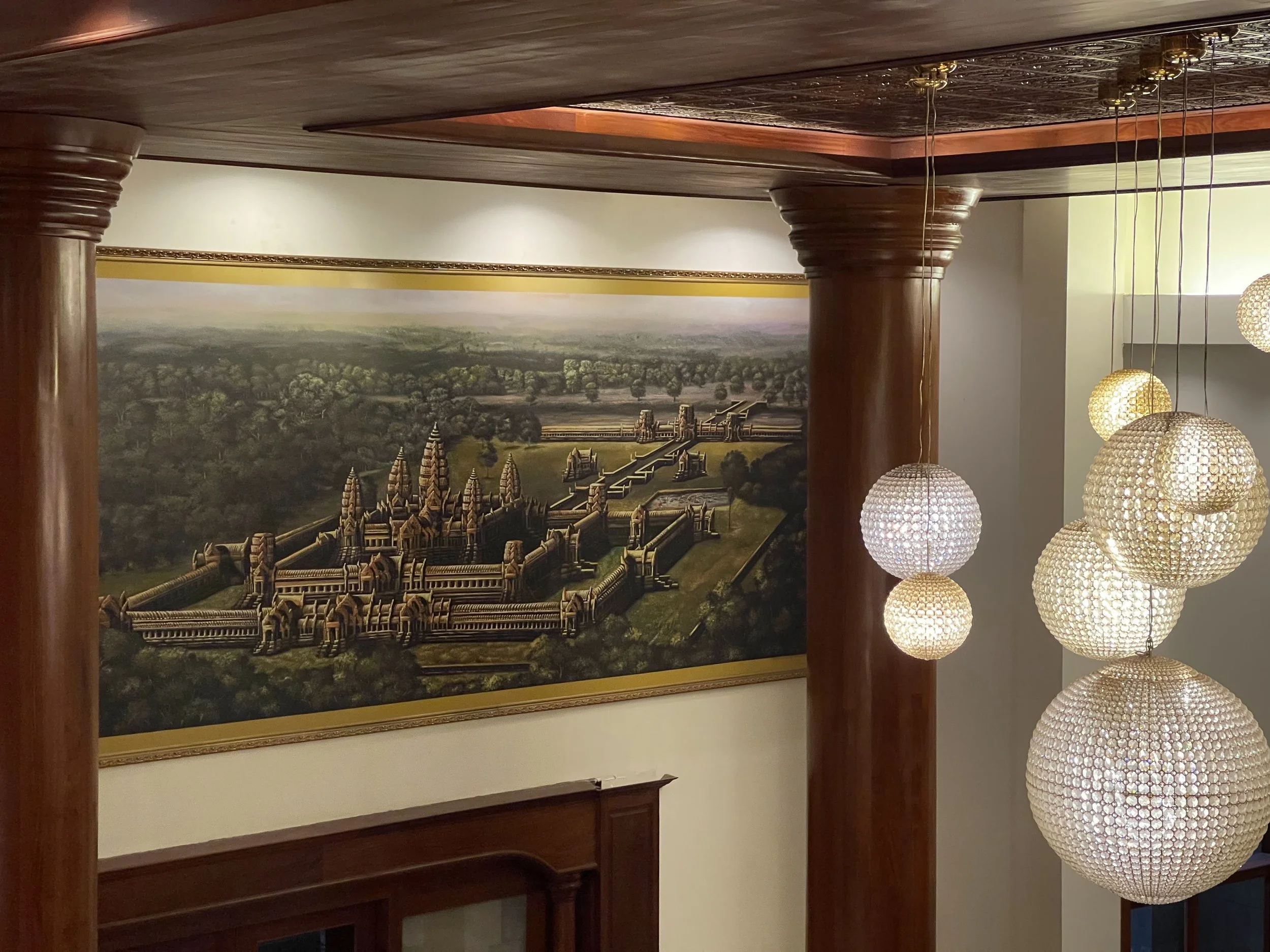
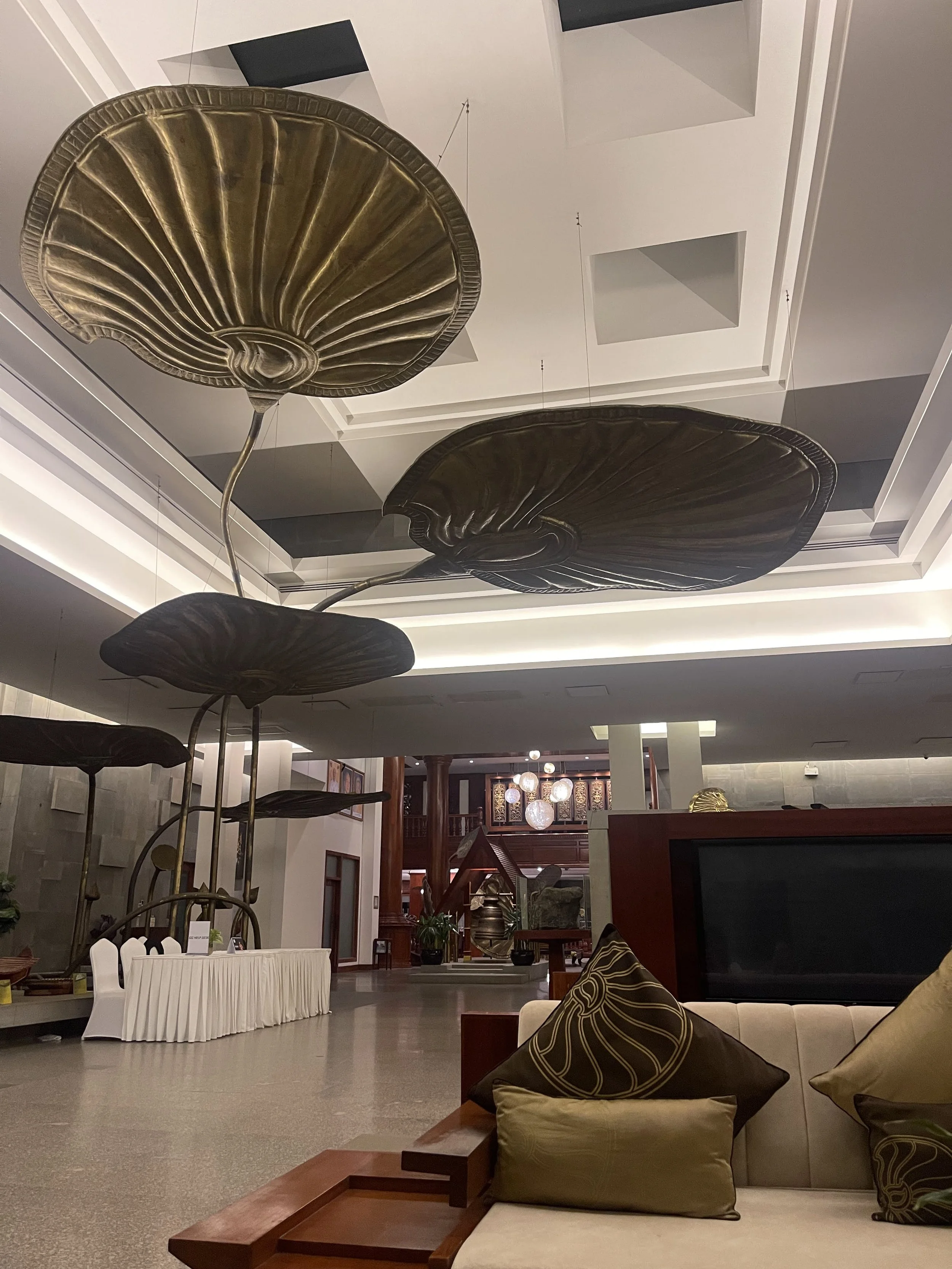
After waking up just early enough to take advantage of a sumptuous breakfast buffet, we hopped into the back of a tuk-tuk and set out into the jungle.
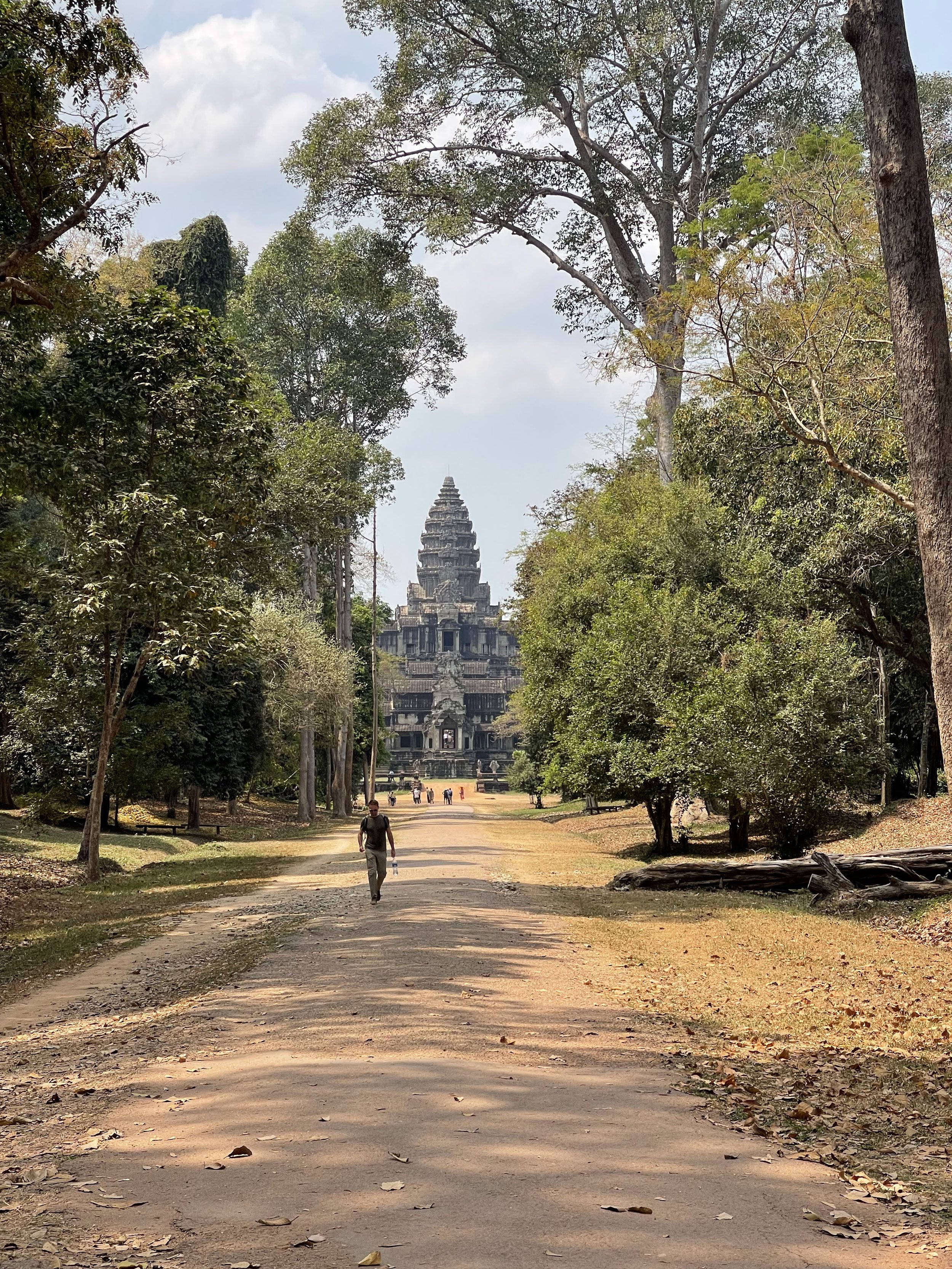
We soon reached a moat almost 200 yards across and nearly a mile long. From here, we’d have to walk. Fortunately, King Suryavarman II had built a bridge 900 years ago, so we walked across stone into the ancient temple complex known as Angkor Wat.
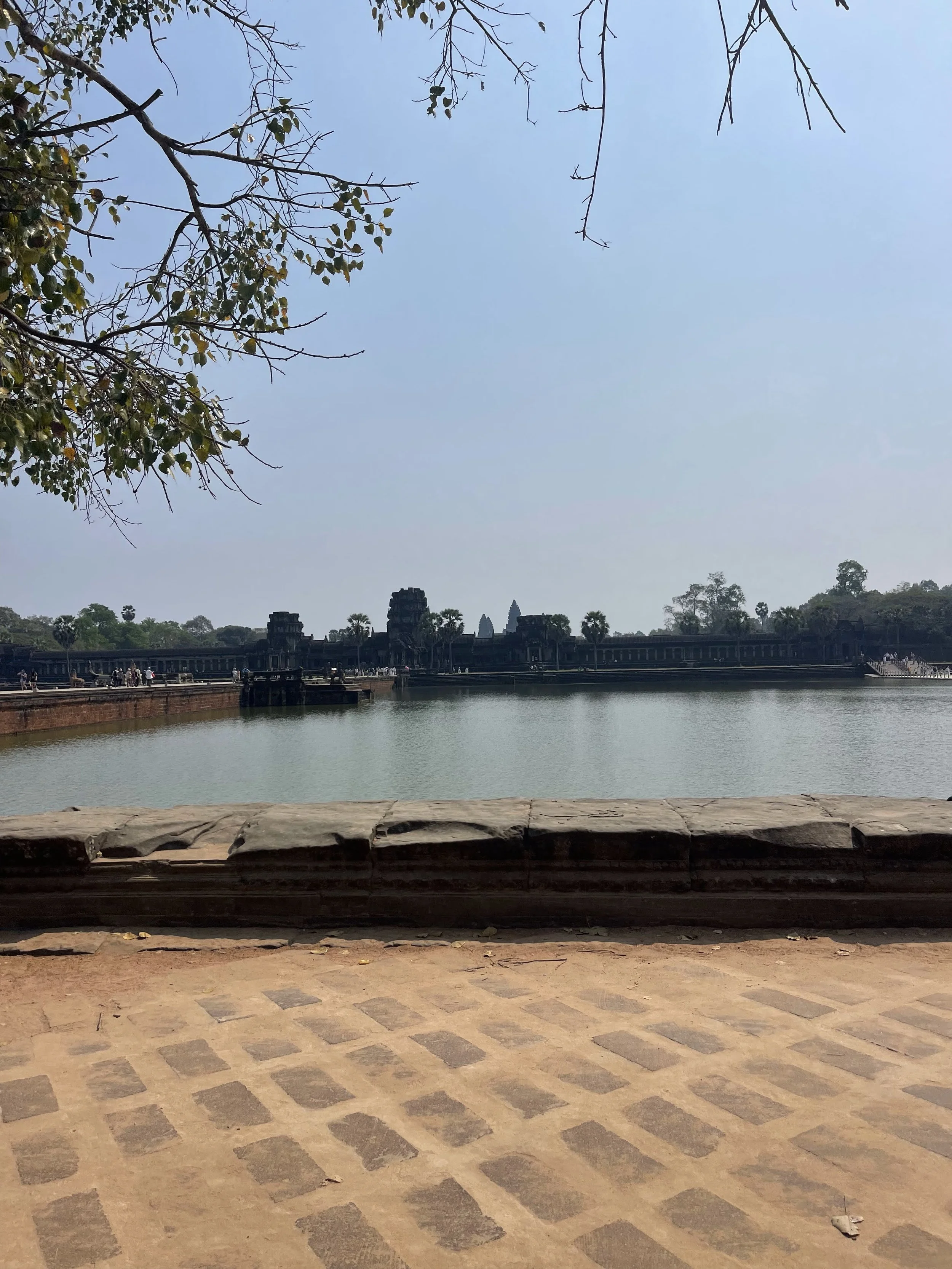
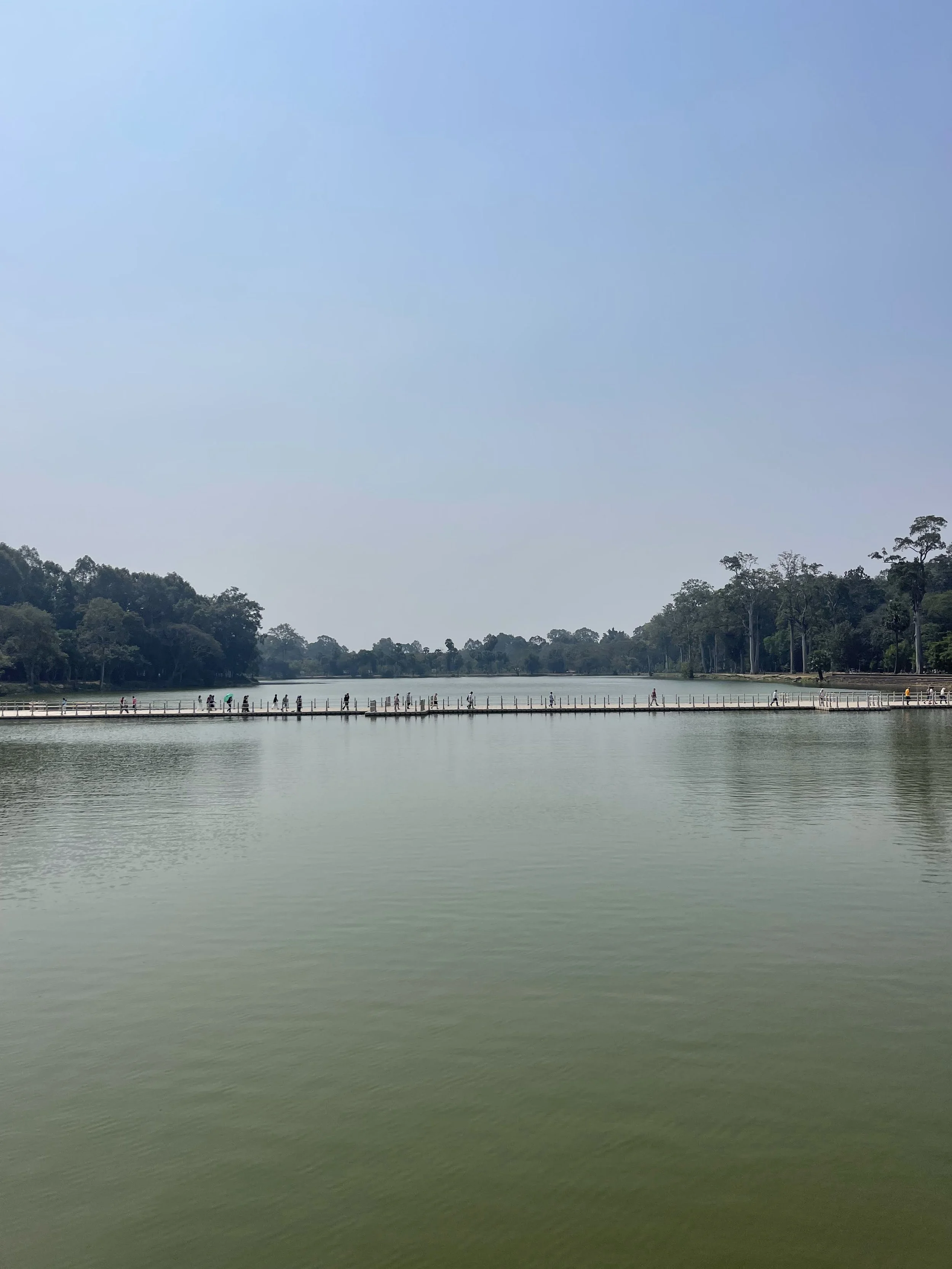
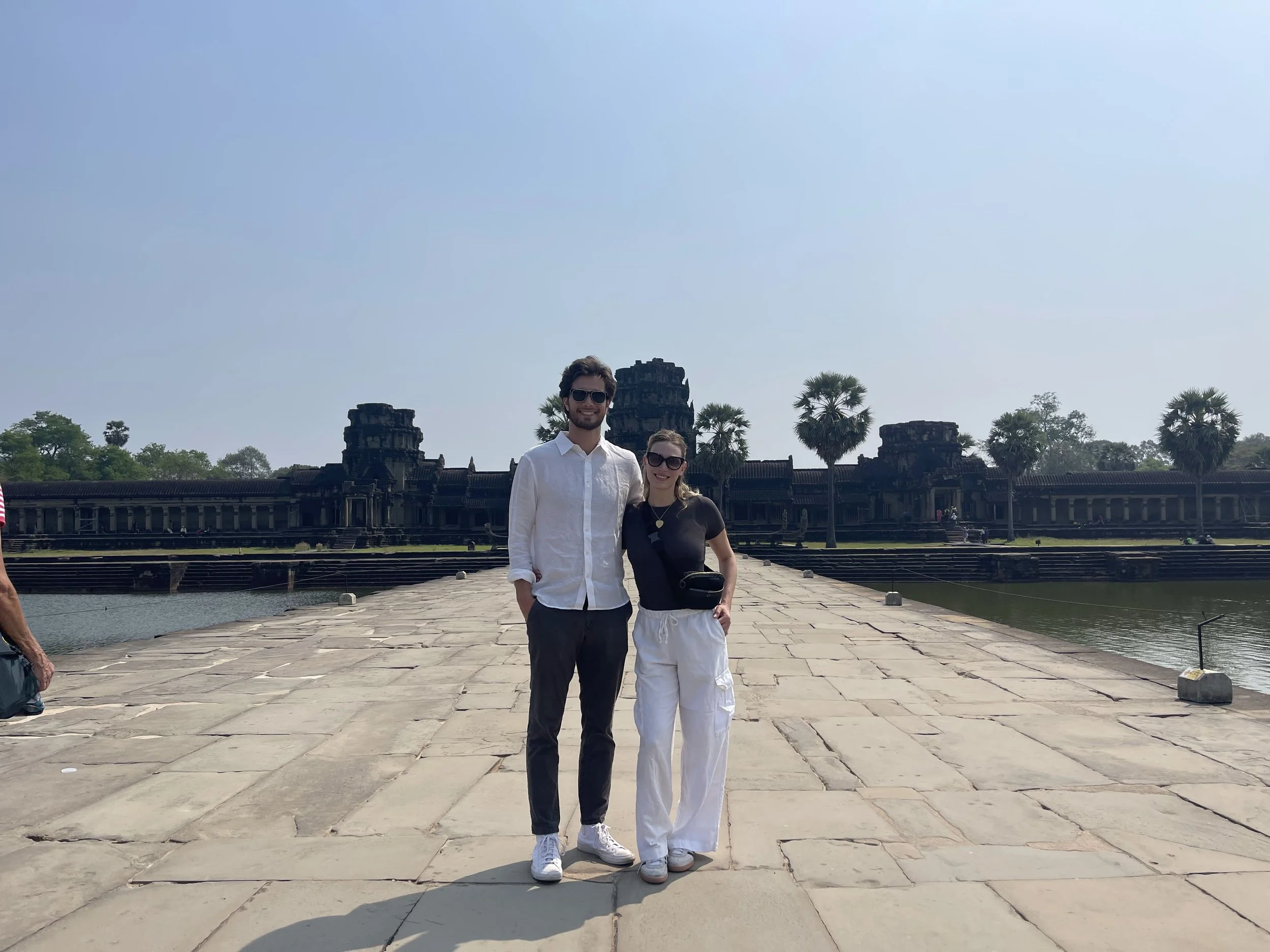
This Wat (or “temple”) had been the center of the ancient city of Angkor. Rather than acting purely as a defense mechanism, the moat contributed to the Hydraulic City’s advanced water management system, which handled the annual monsoon cycle effectively enough to irrigate rice sufficient to feed nearly 1 million people.
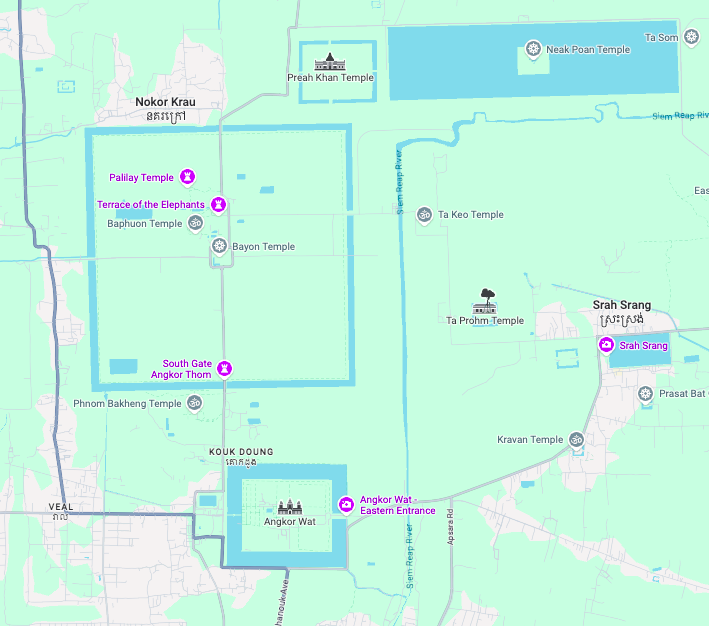
We entered the temple grounds just before 11am, yet most people had already come and gone; sunrise is the most popular time to visit the ancient ruins, both because of the beauty of the colorful sky and because the temperature hasn’t peaked yet. “The sun is smiling down on us,” our guide remarked euphemistically.
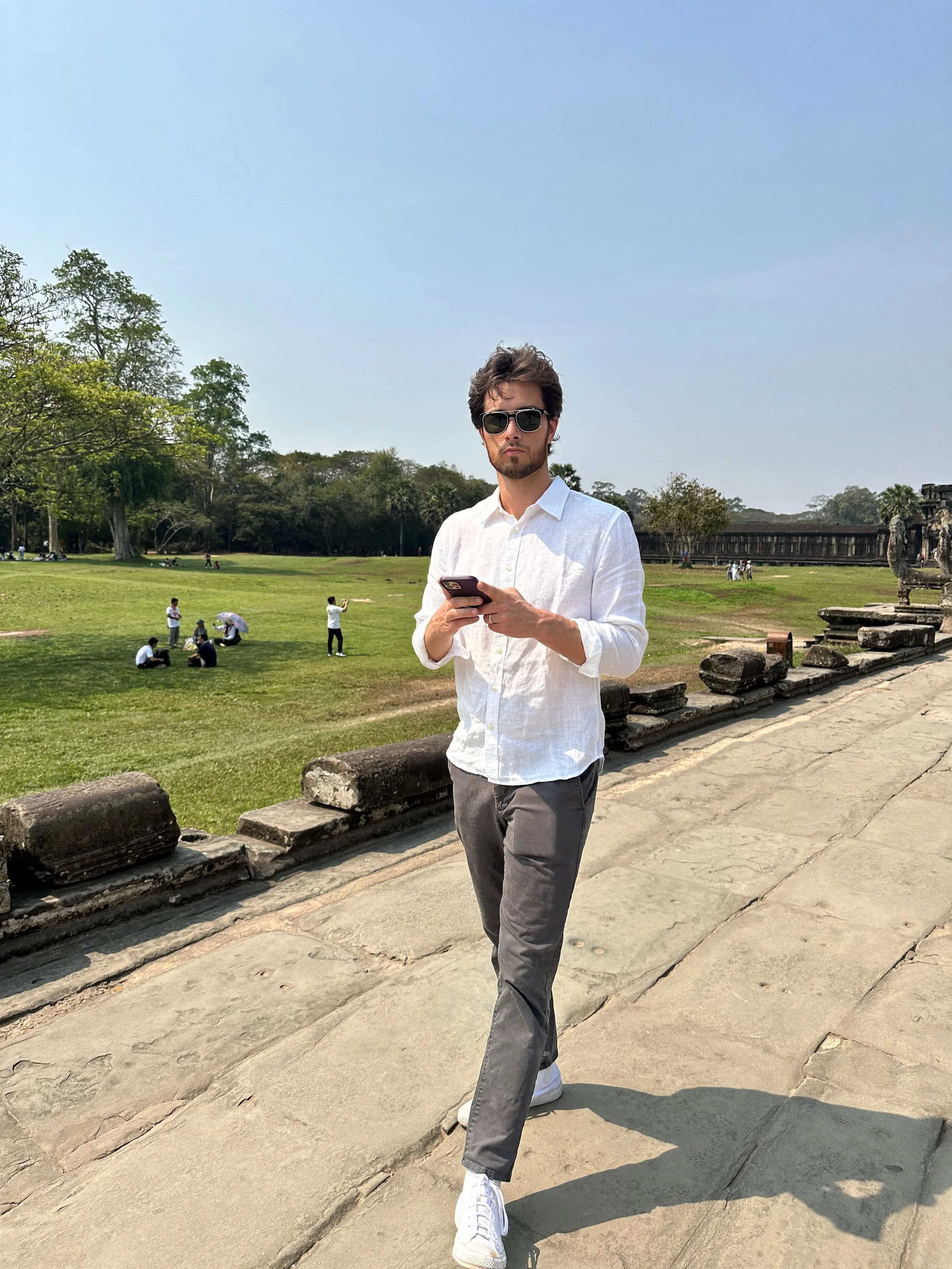
I, on the other hand, wasn’t smiling back at the sun
Those ruins lend a haunting majesty to the jungle, almost seeming to have grown naturally out of it. The closer we got to them, the better we could witness their live-action process of decay: the crumbling stone of the edifice and the crumbled stone surrounding it. So it took us aback when we finally got up close to the walls and could make out the insane level of detail of the bas-reliefs, parts of which look as if unchanged since the day they’d been carved.
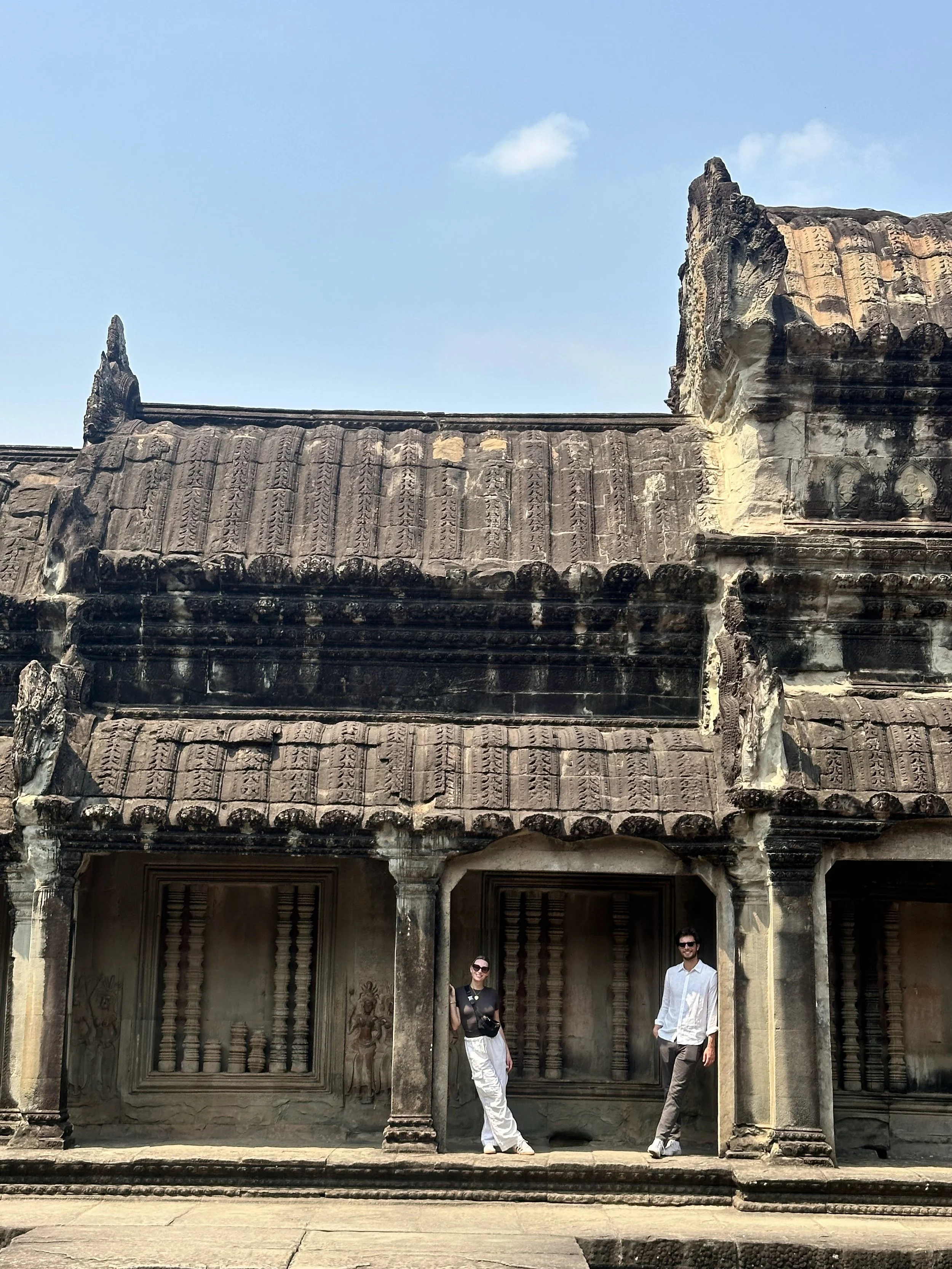
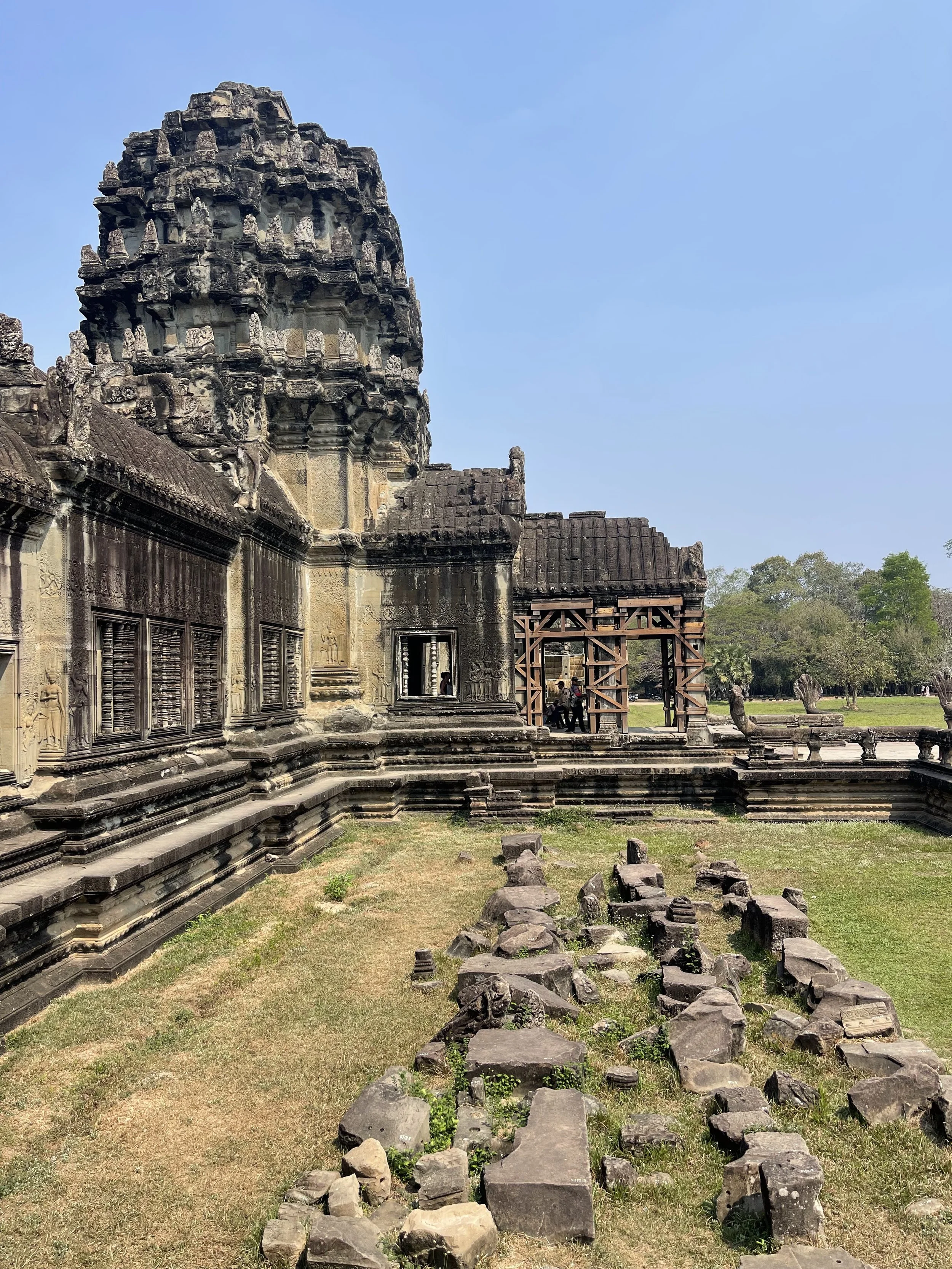
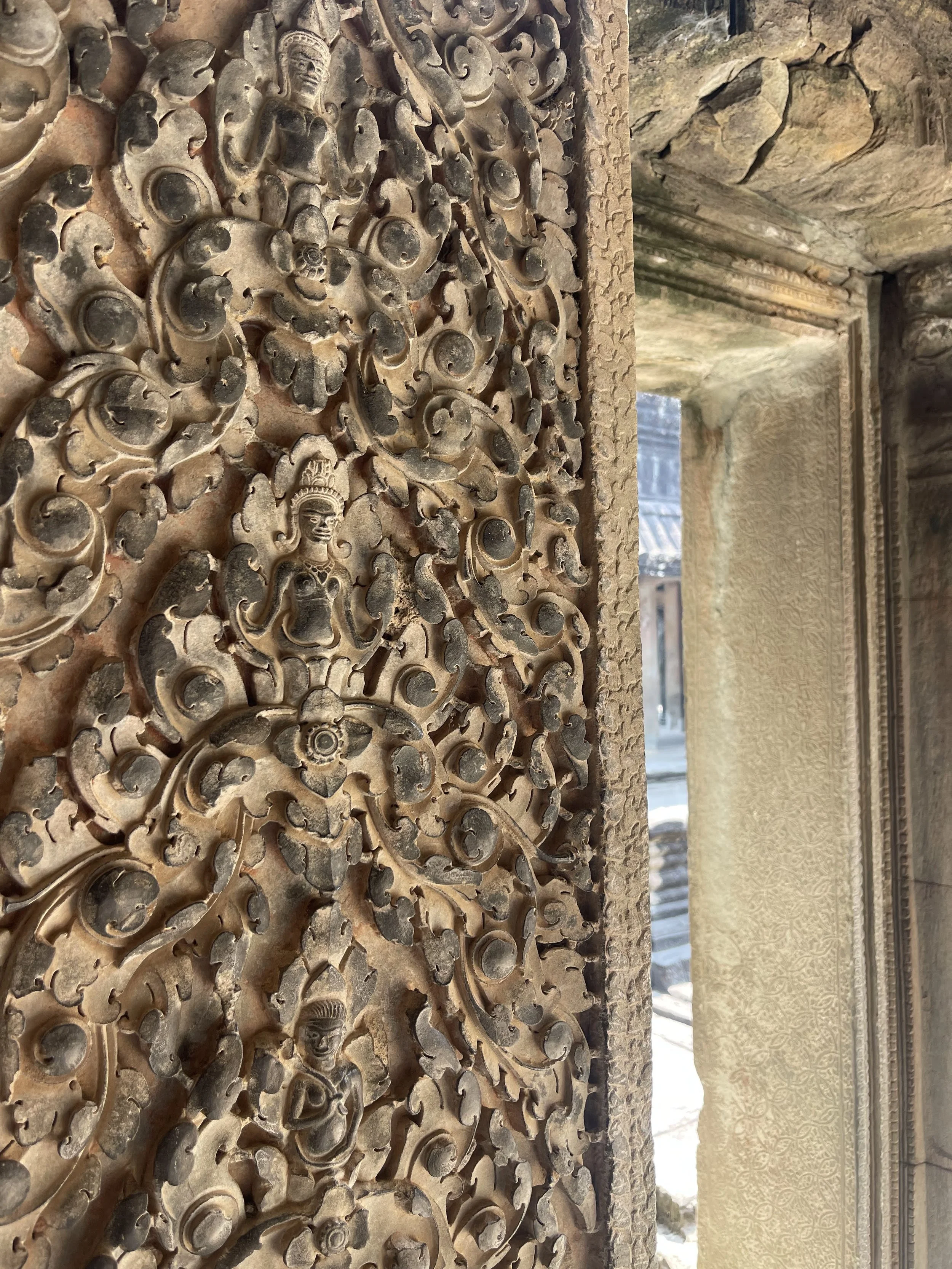
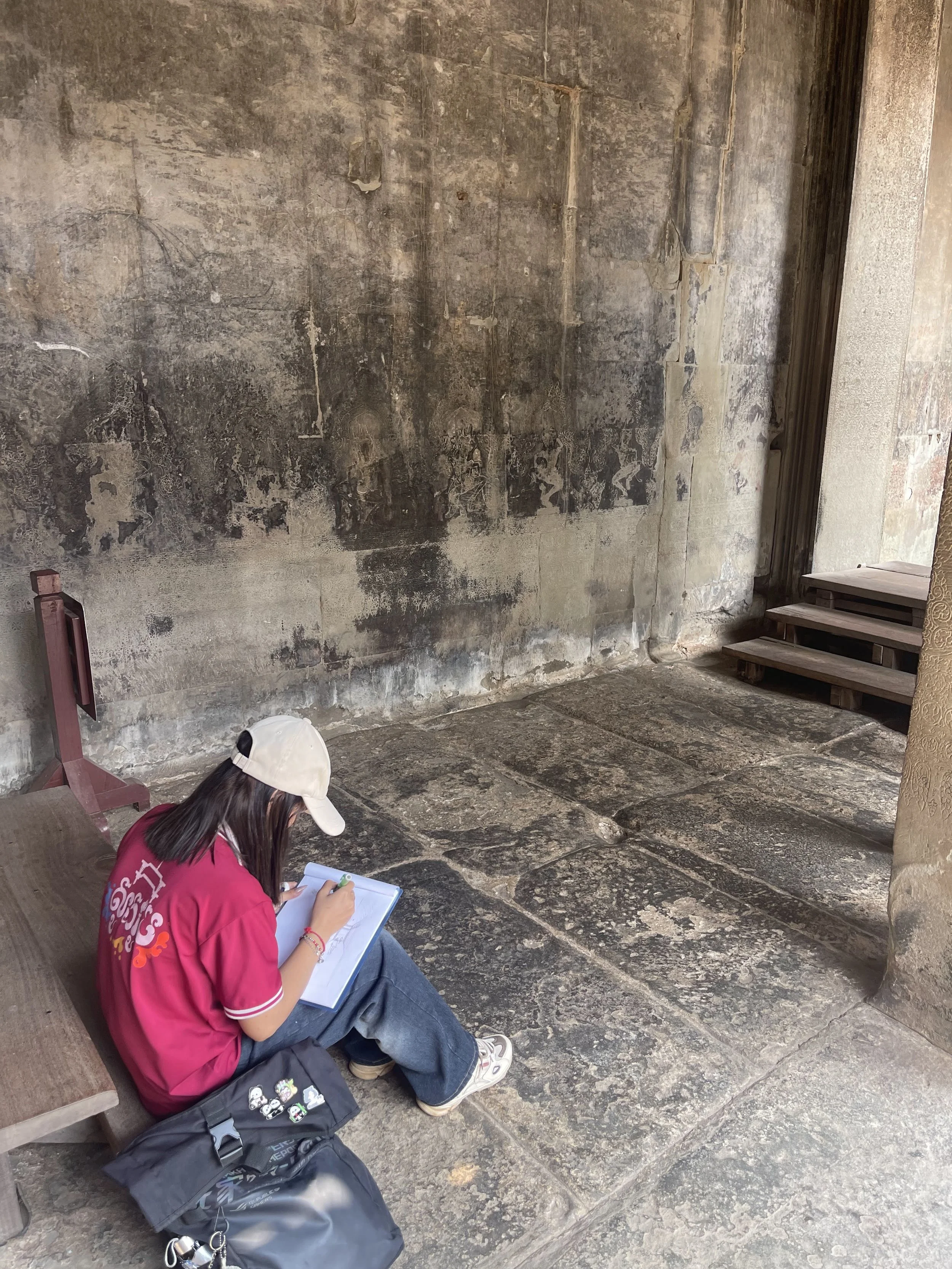
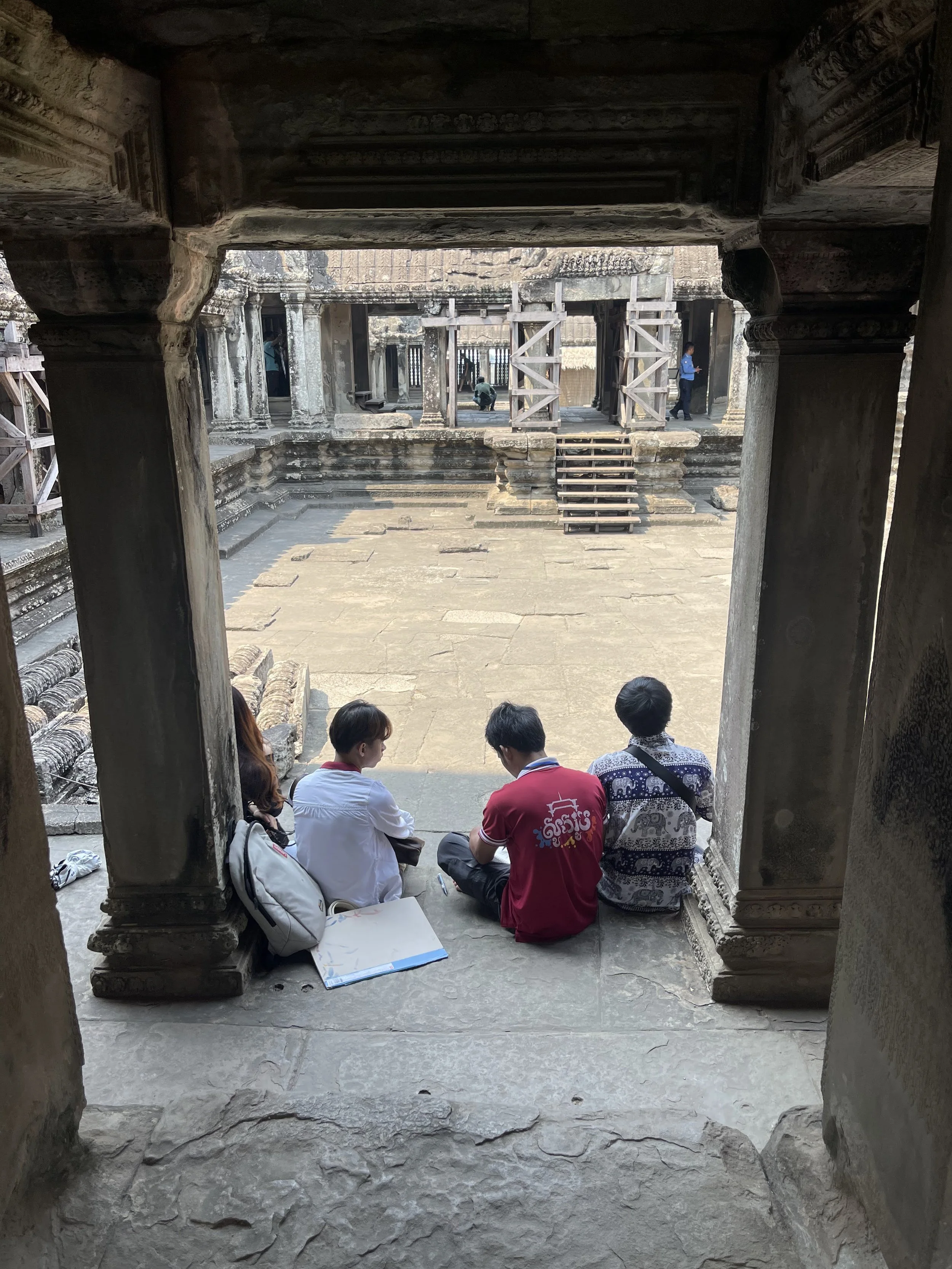
Throughout the complex, sketchers sat in front of the stone characters, recording reproductions of their own that doubtless will become lost to time before the ancient stone will.
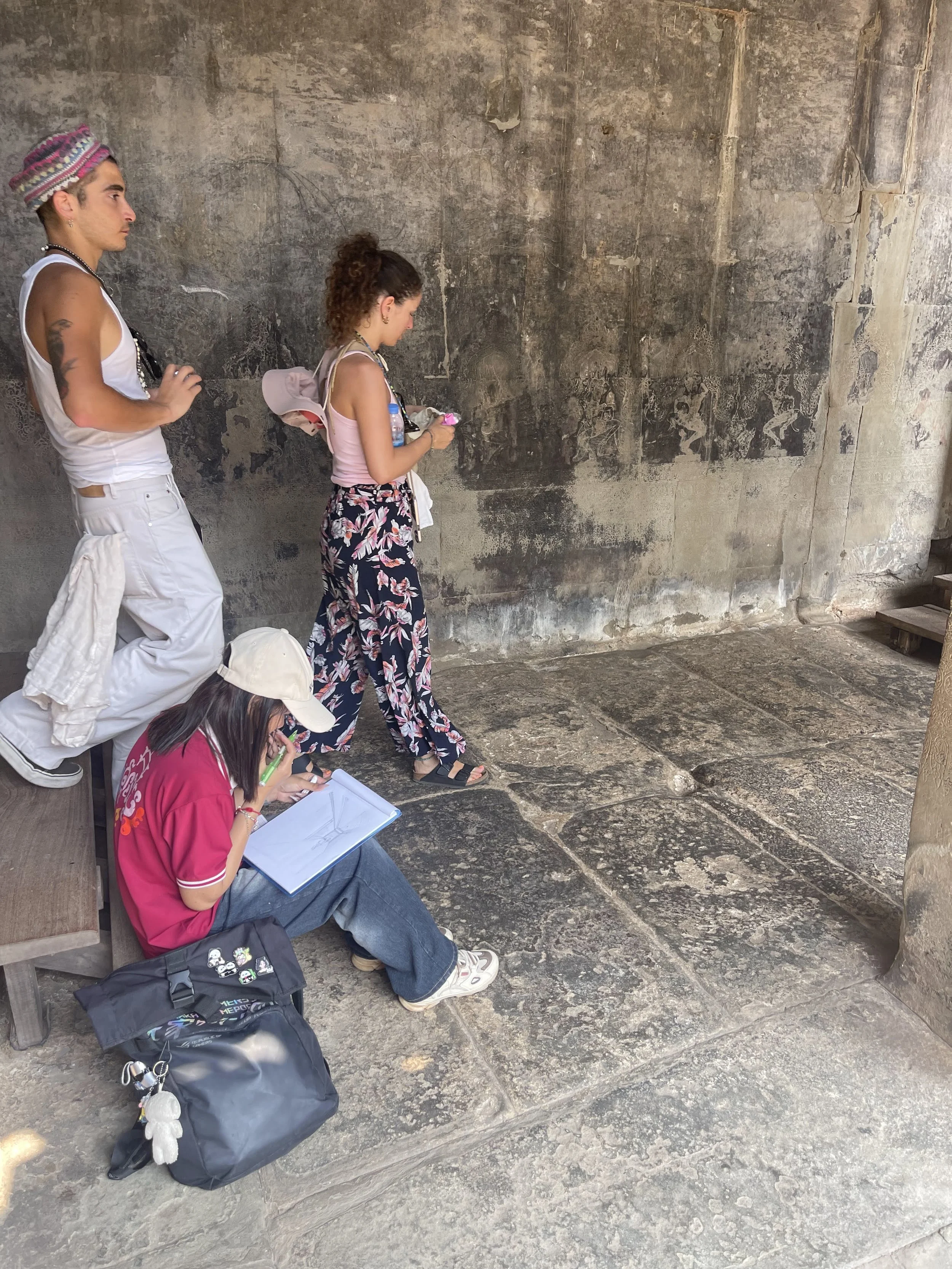
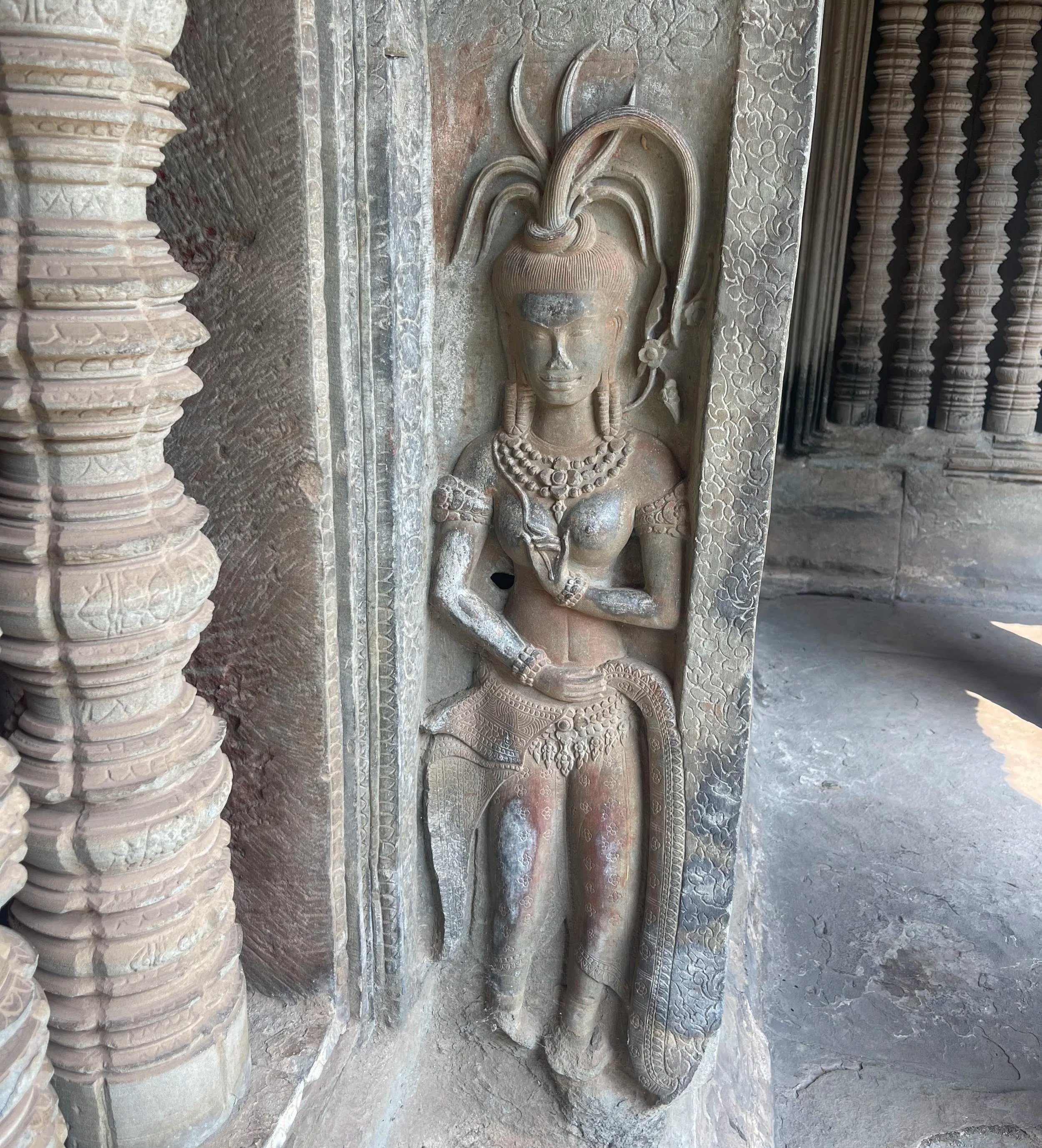
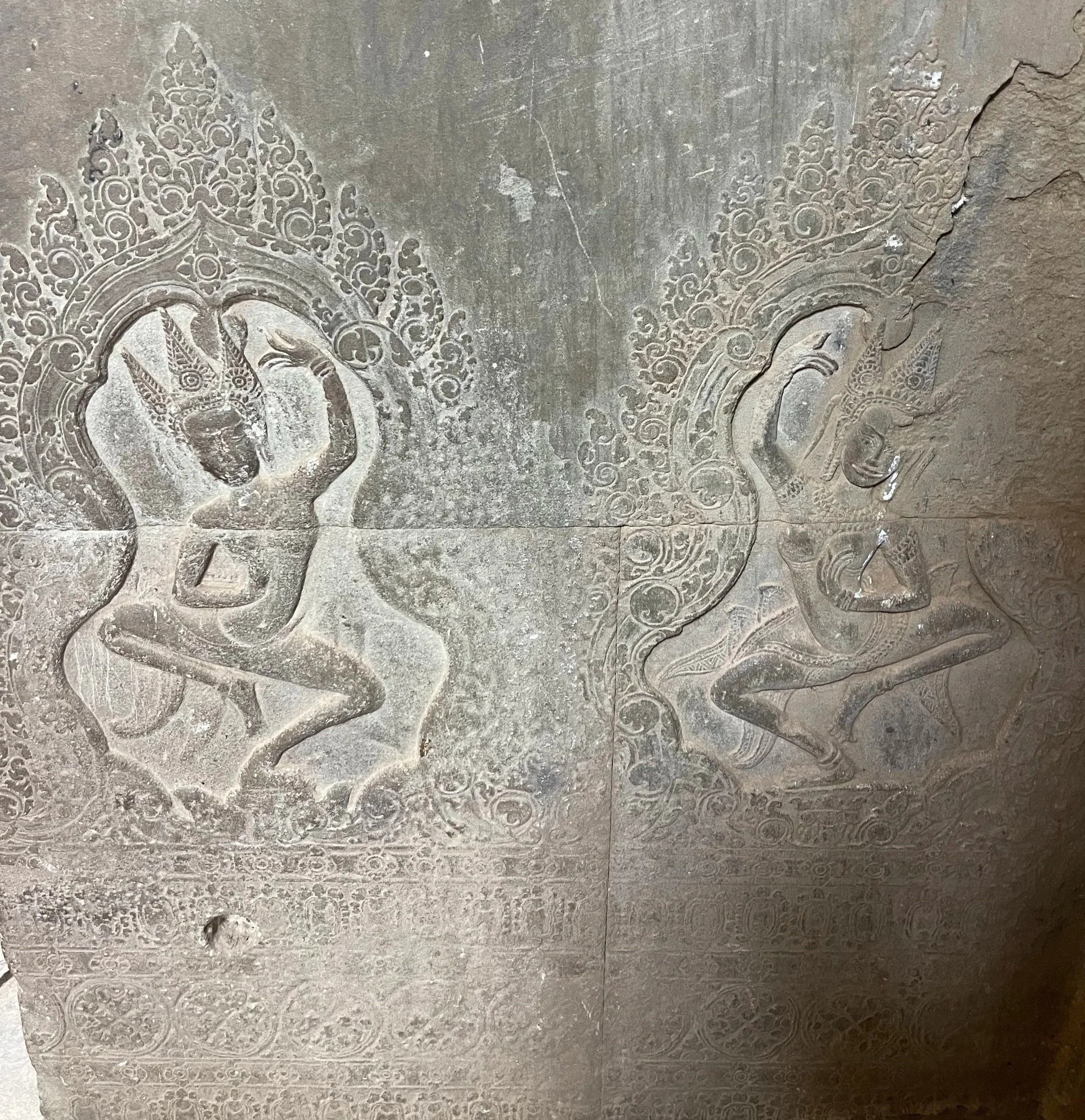
Some of the reliefs depict Devatas – or guardians – who watch over the temple grounds. Others display dancing Apsaras, who bring a bit of levity to the grand temple. And still others tell stories, for instance the Hindu myth of the Churning of the Ocean of Milk, in which gods and demons wrapped the serpent king Vasuki around a mountain and pulled together in an effort to extract the elixir of immortality.
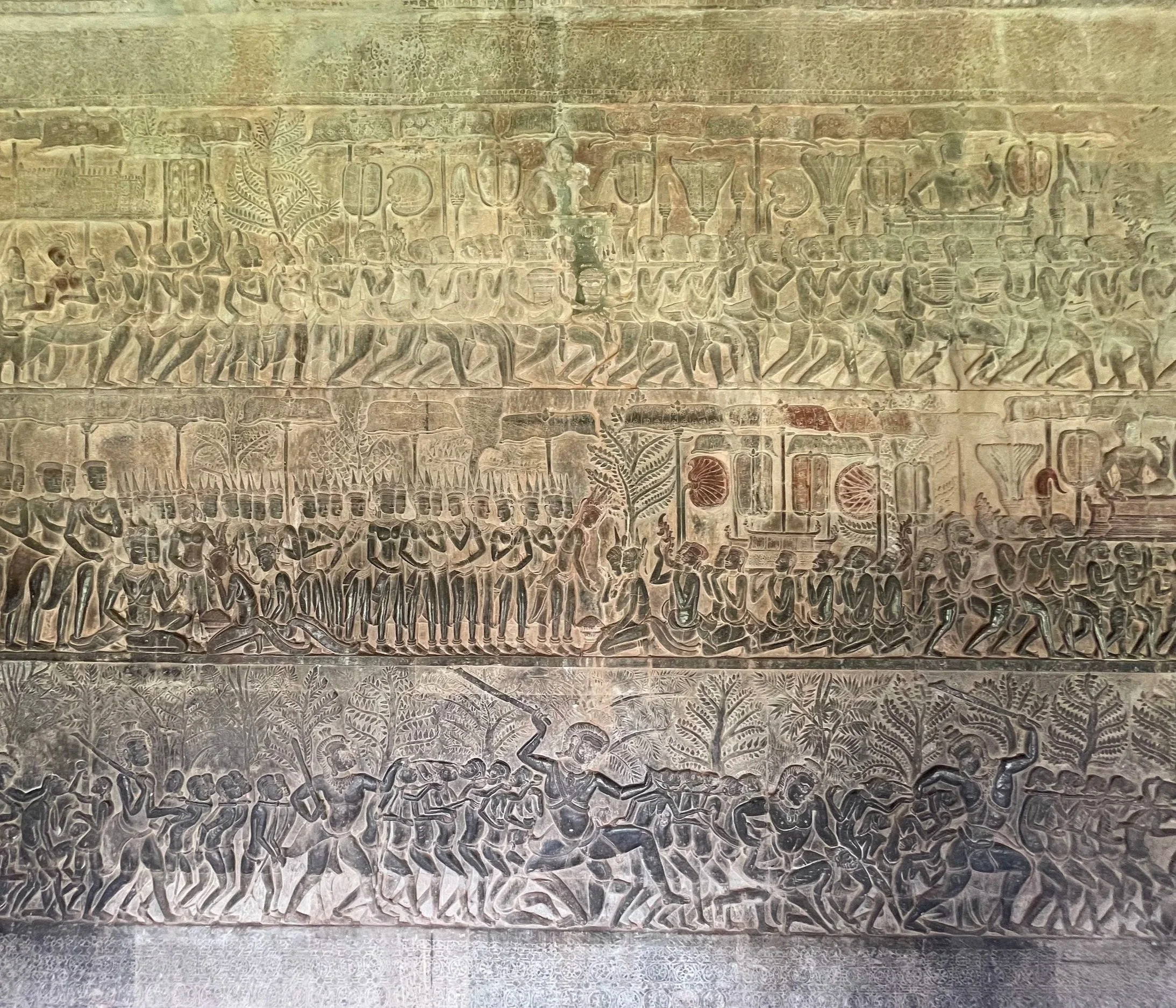
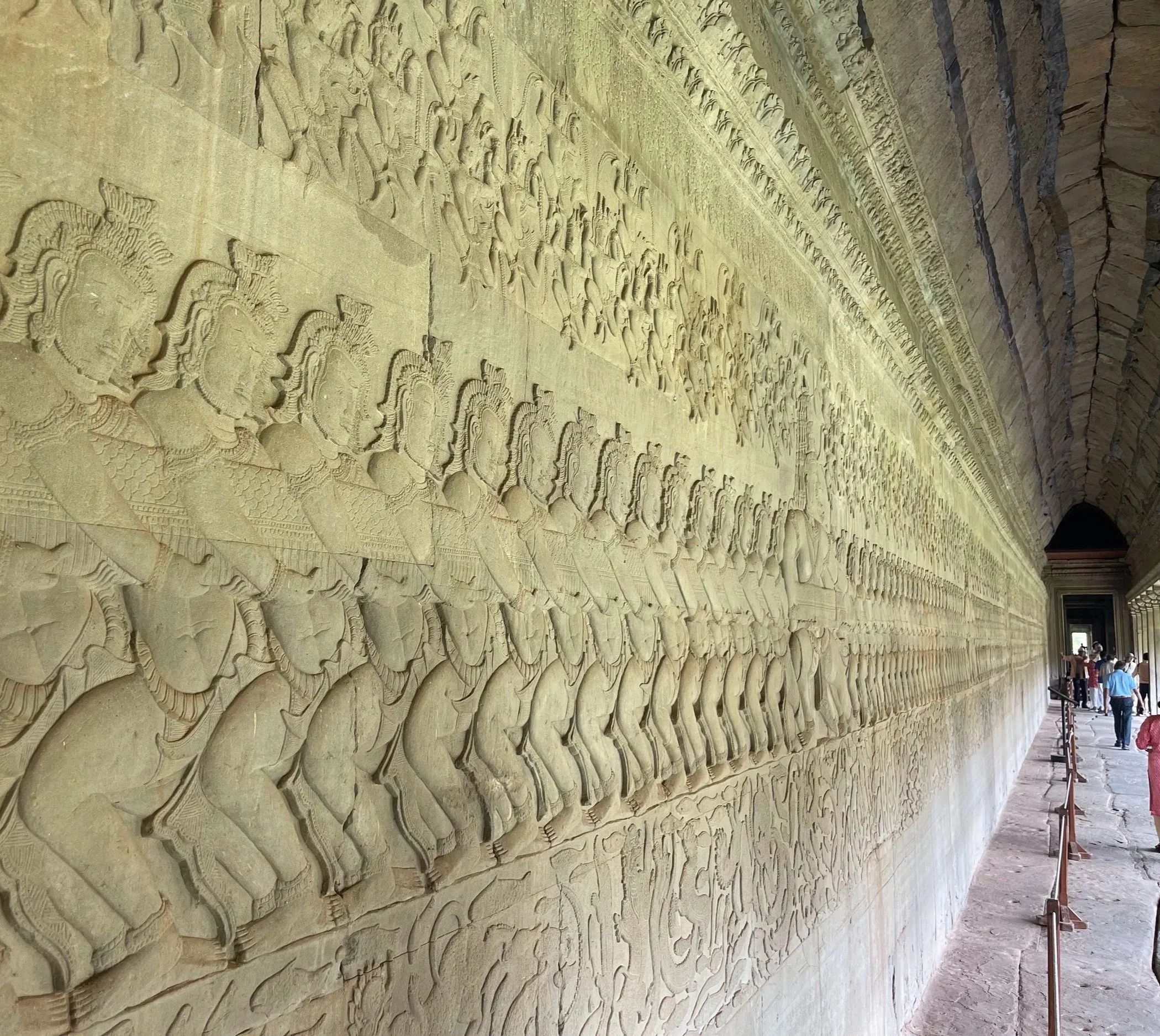
On the main promenade we walked towards the central bulbous structure. To our left lay a cluster of tents in front of buildings: these constitute the shops and restaurants that make up the modern ‘town’ of Angkor. In their foreground, we stopped at the Northern Library, where in absence of paper they wrote on palm leaves, animal skin, and stone tablets.
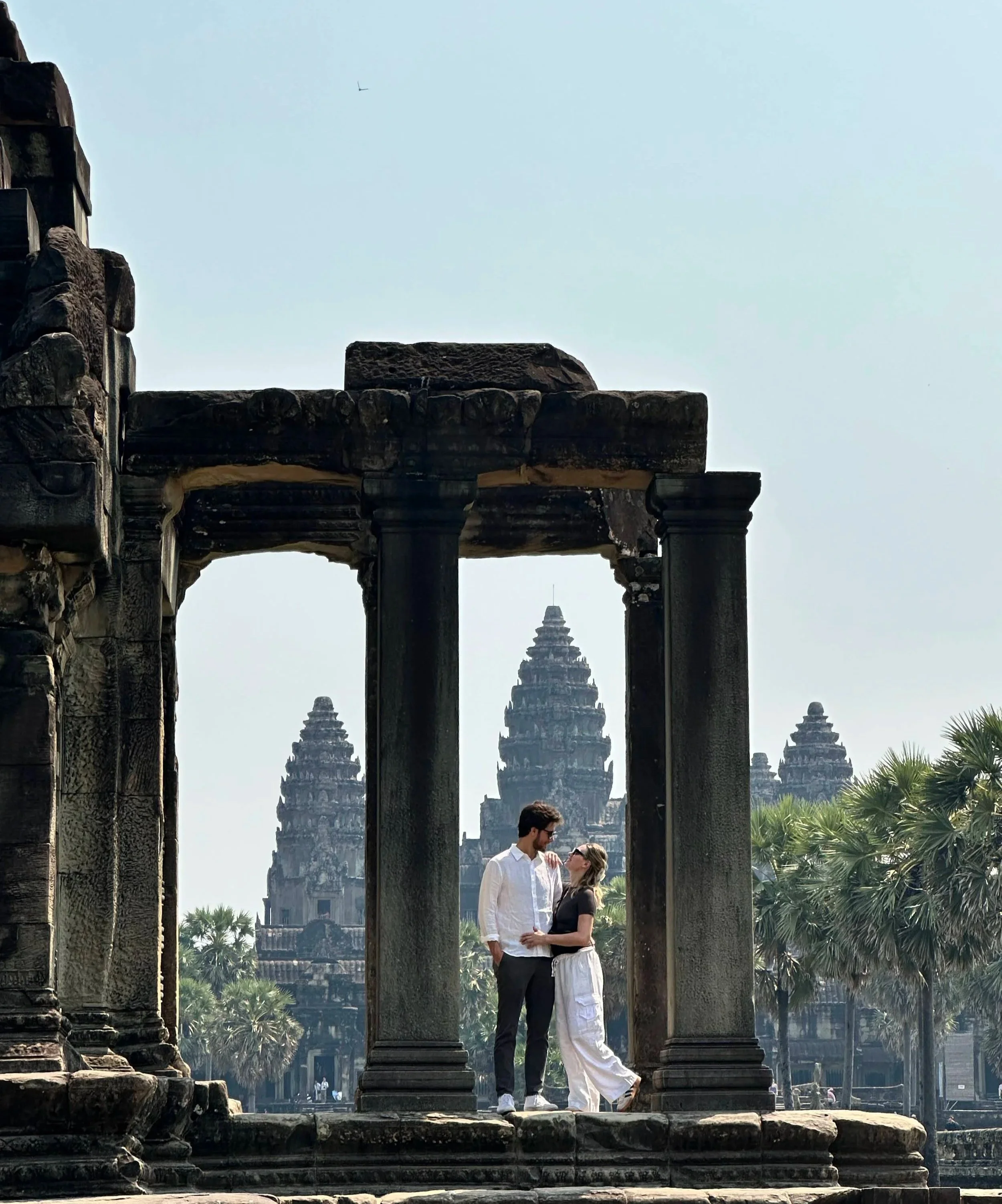
Under the portico of the Northern Library
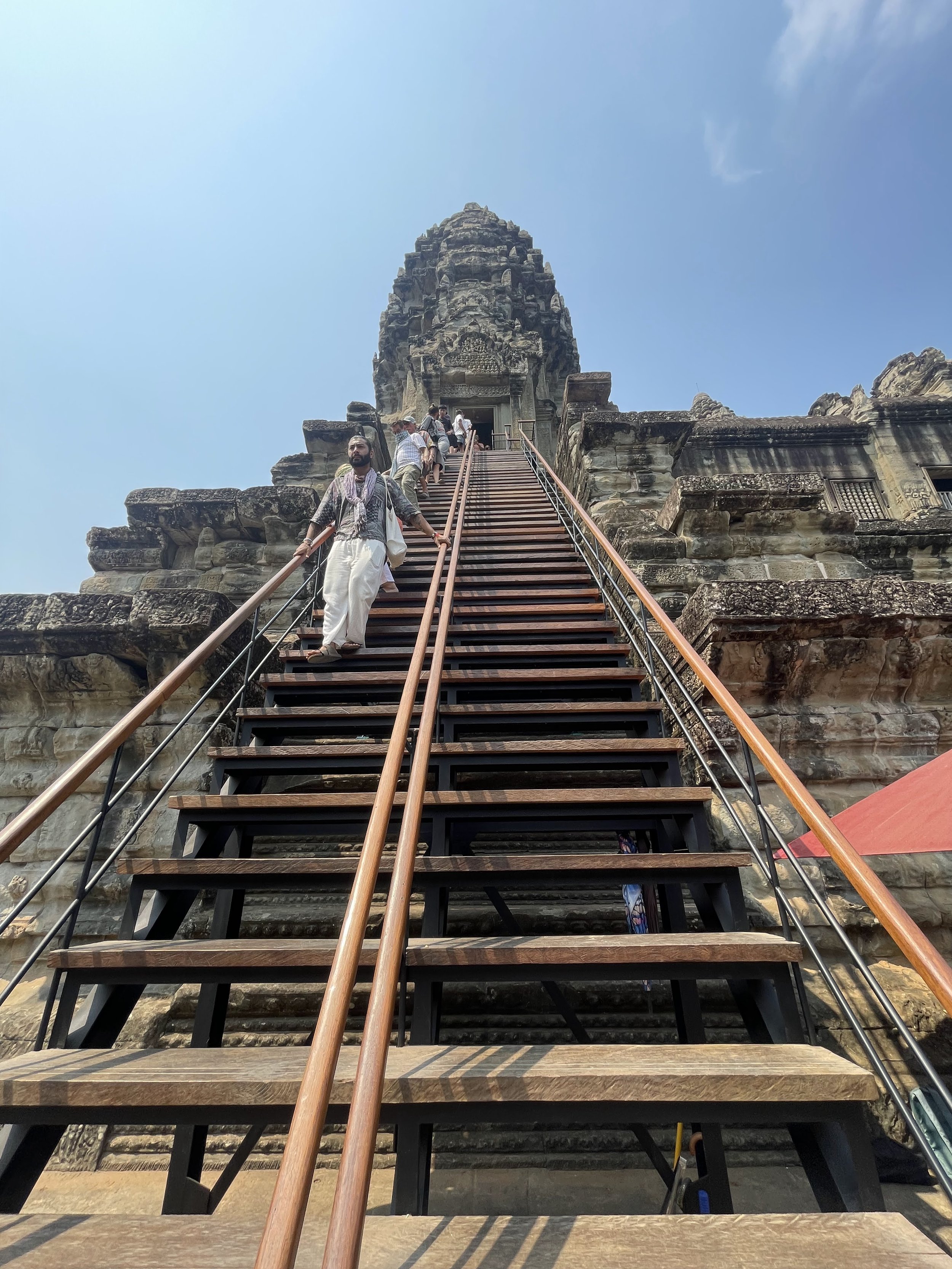
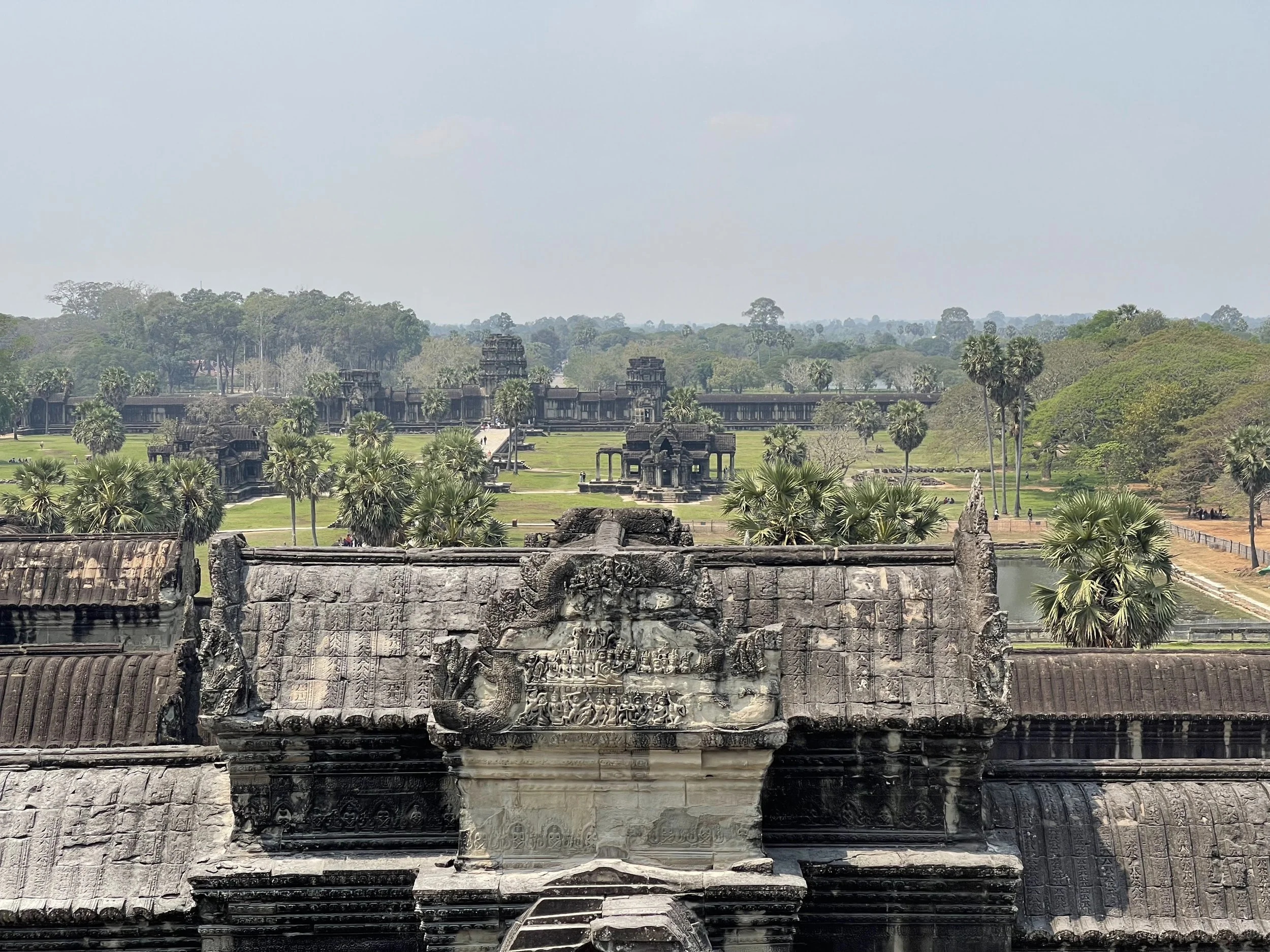
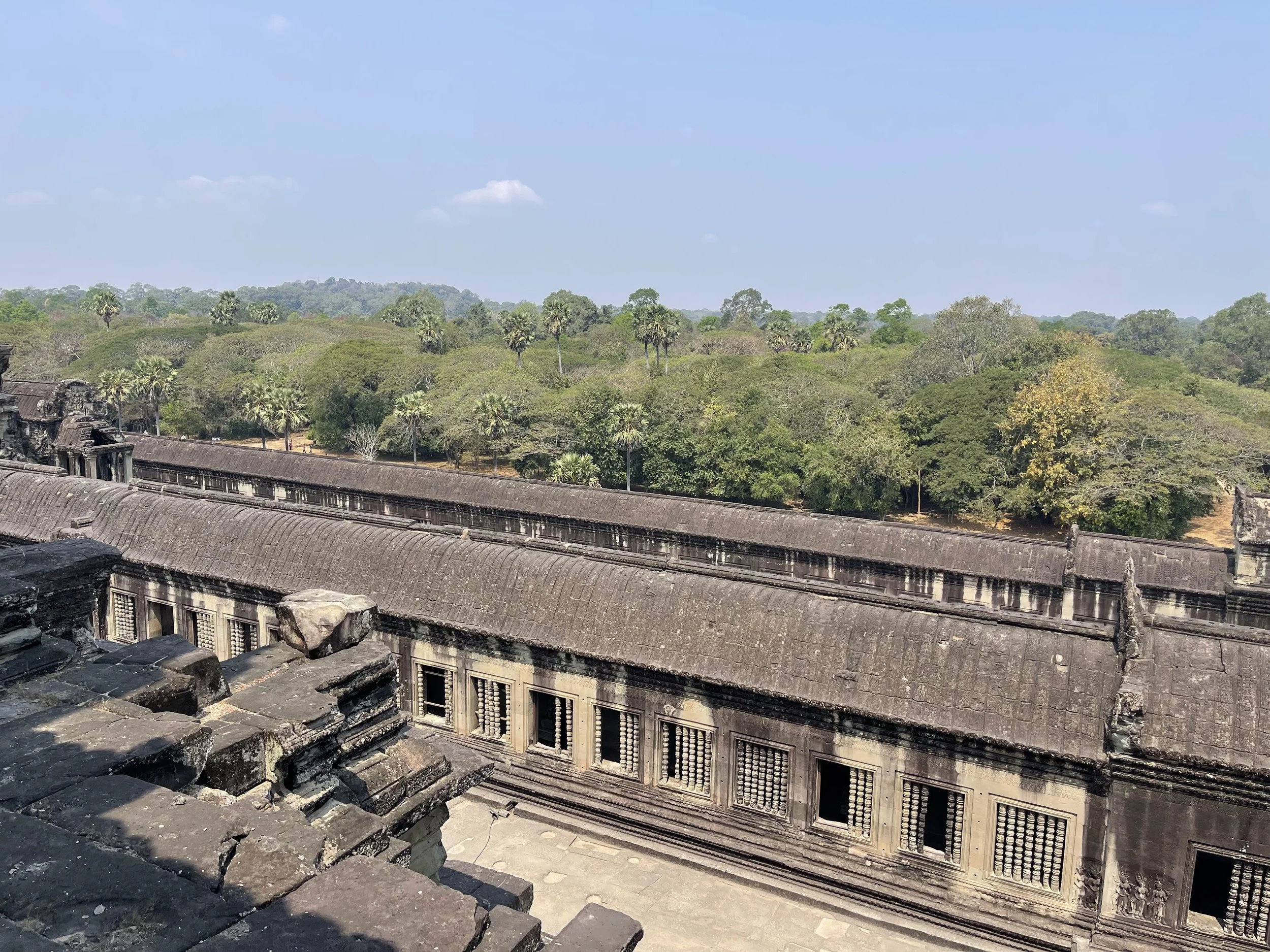
Once in the center complex, we made a steep climb up wooden stairs to the interior of the temple’s iconic bulbs. From here we gazed out into the distance. Save for the tents, it looked — I imagine — much the same as it did to the Khmers when they surveyed their ancient empire.
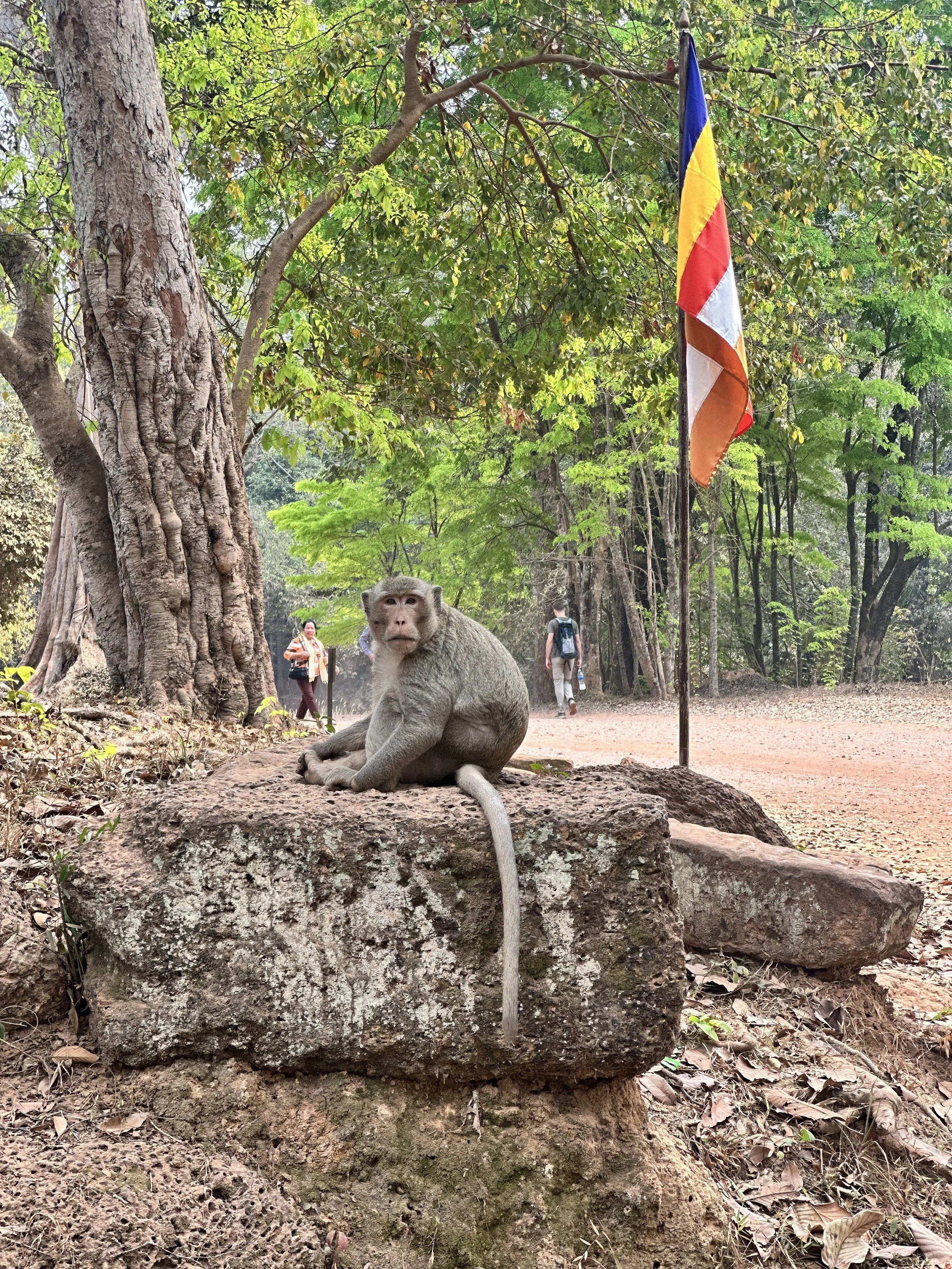
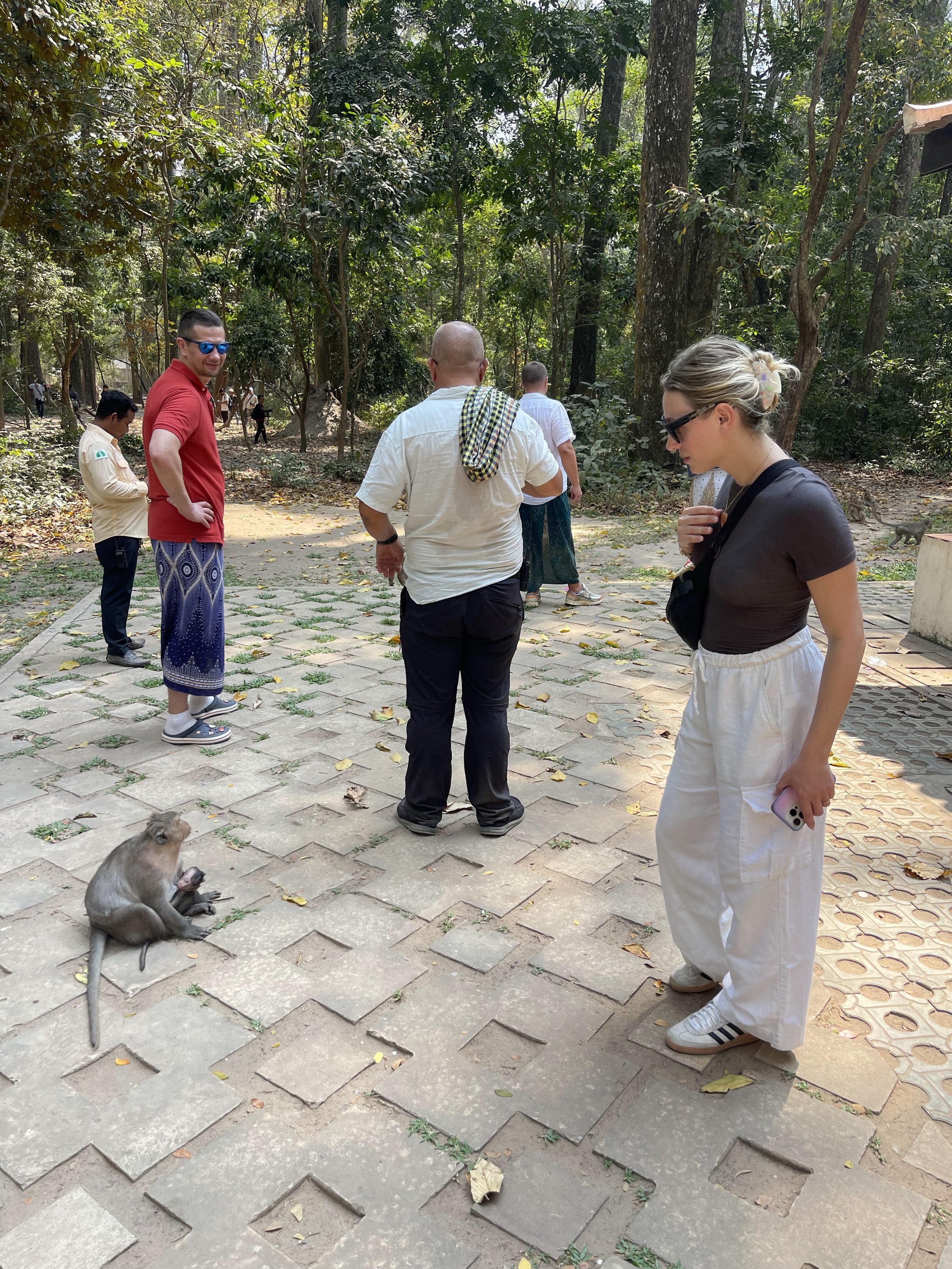
On our way out of the temple, the wildlife started to emerge. First we encountered a solitary macaque sitting and staring into the water in contemplation. Then we heard a rustling in the trees and saw his cousins — the kids scurrying up and down in play as their parents looked on. Later on, near a bathroom building we’d see groups of monkeys intermingling with people, one climbing on a man as if he were a tree, two kids scrapping in the dirt, a mother nursing her baby, and two parents guarding their child.
Our tuk-tuk driver met us at the eastern entrance and we passed water buffalo lounging in the water on our way to Tonle Om Gate. The stone carvings that line its bridge depict the very same churning as we’d seen in the temple, Vasuki’s seven heads and parts of his body having been worn down by the passage of time.
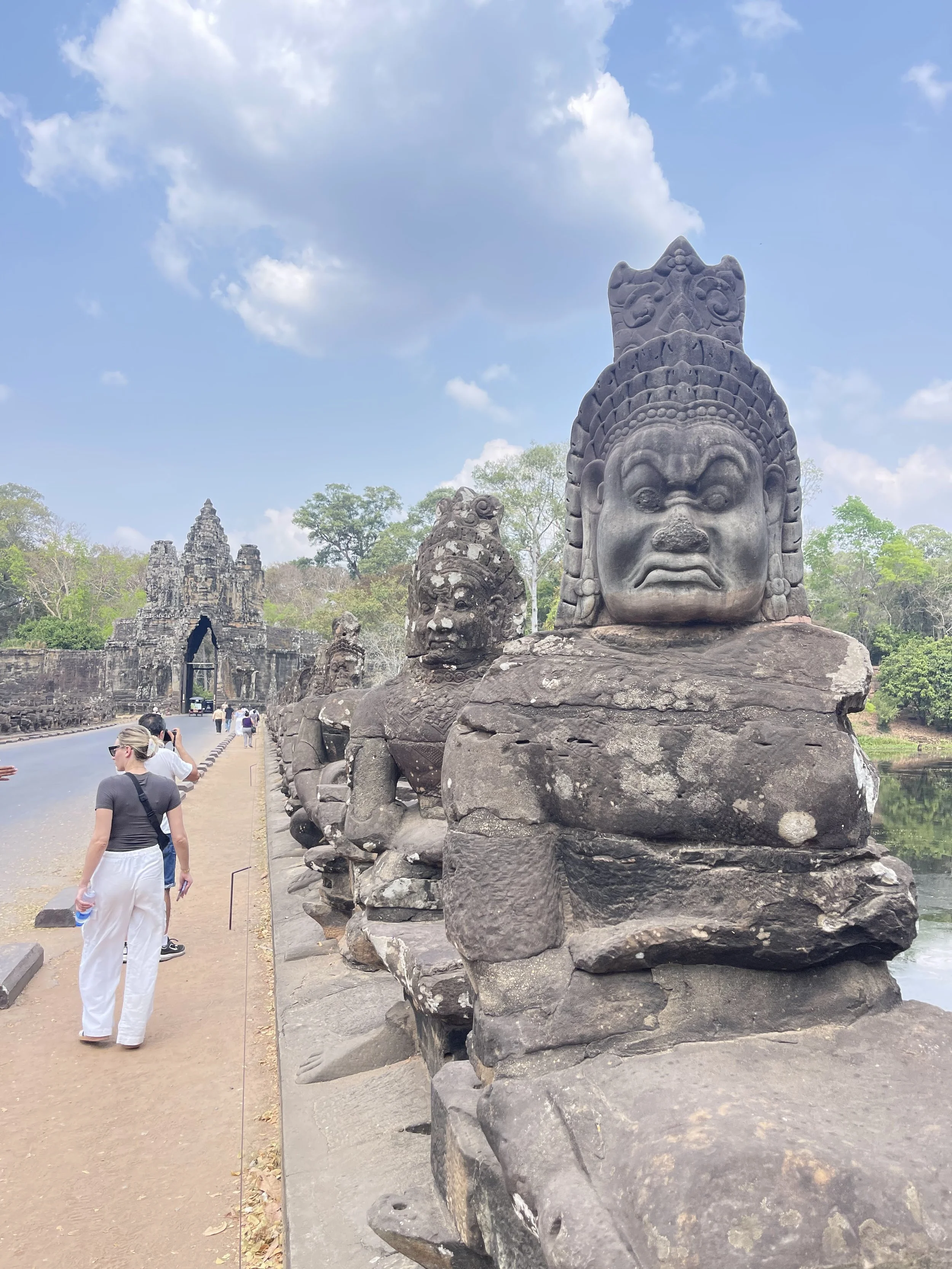
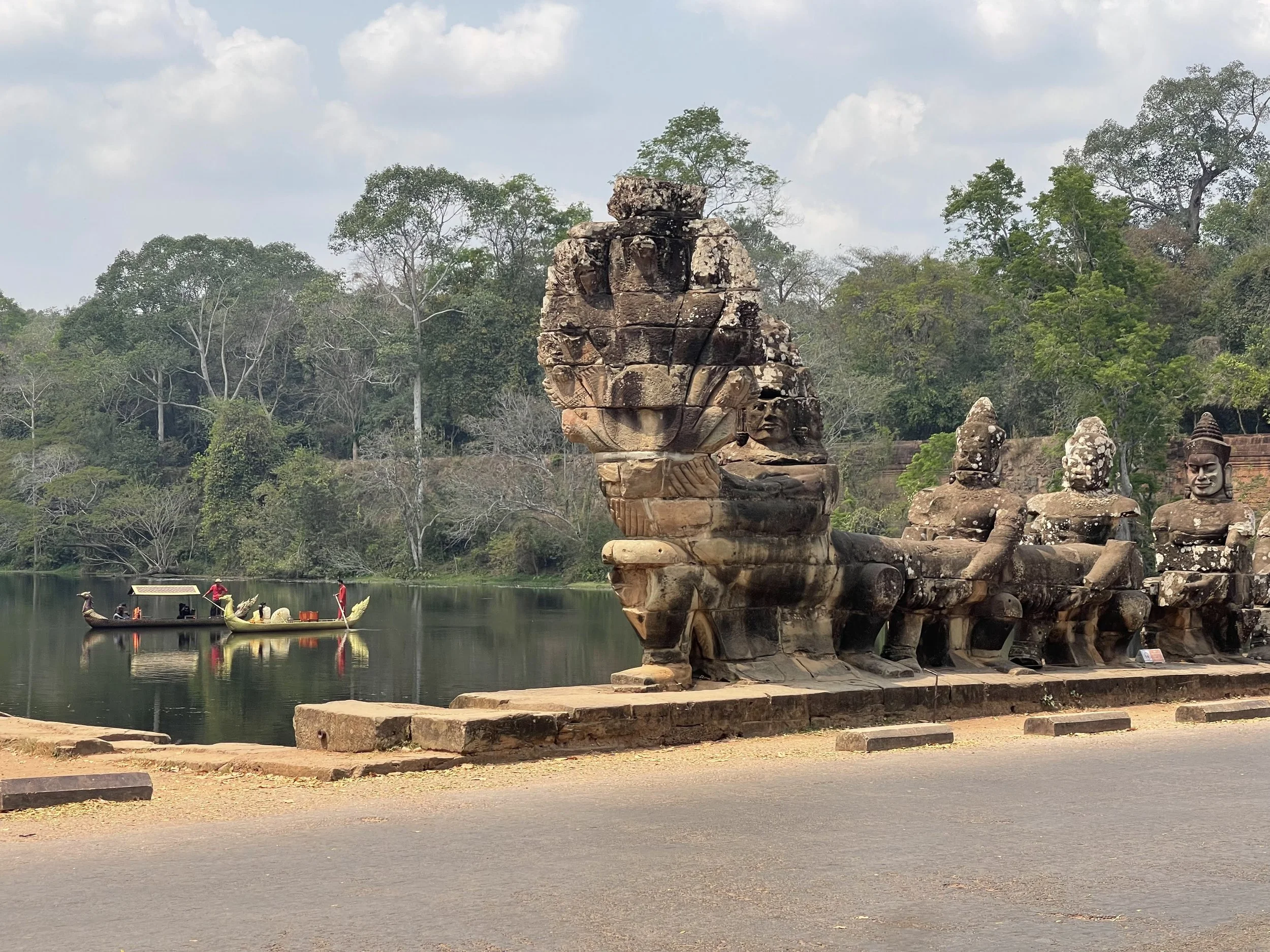
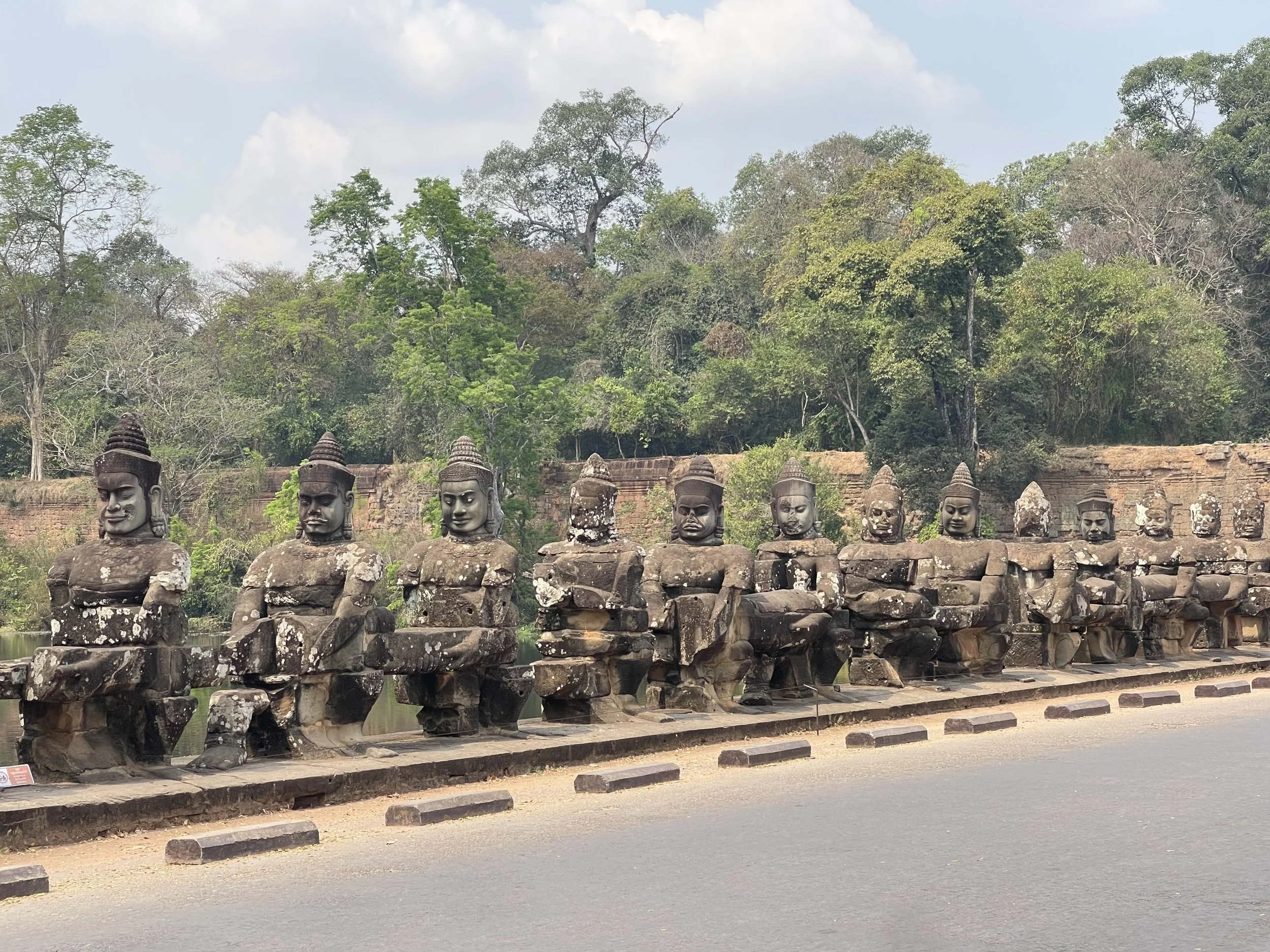
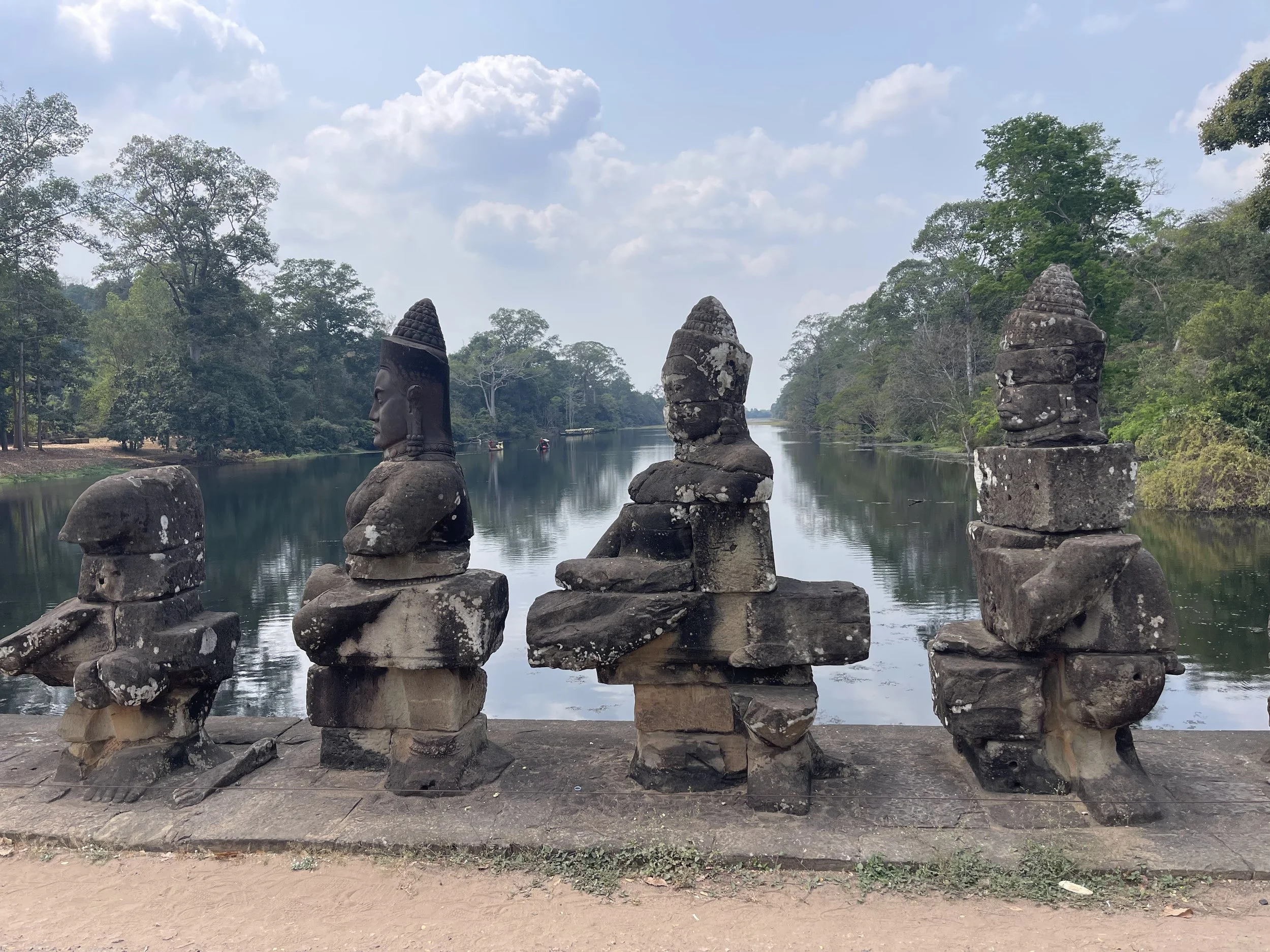
Across this moat, four smiling faces stood guard to the entrance of Angkor Thom — and that same imagery persisted throughout the Bayon Temple, different from Angkor in that it’s predominantly a Buddhist temple and not Hindu, and in that its bas-reliefs depict scenes of everyday people rather than mythological gods.
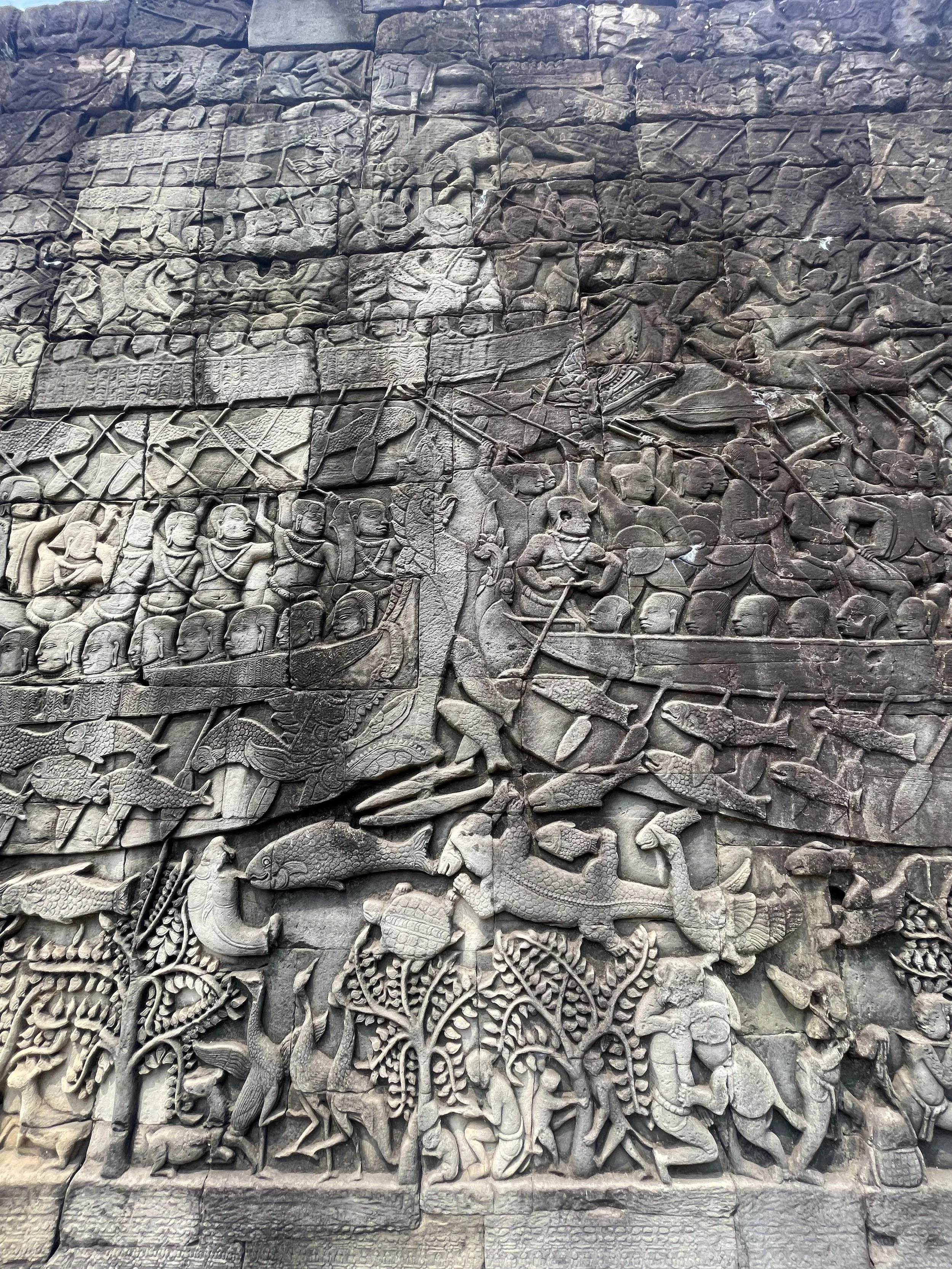
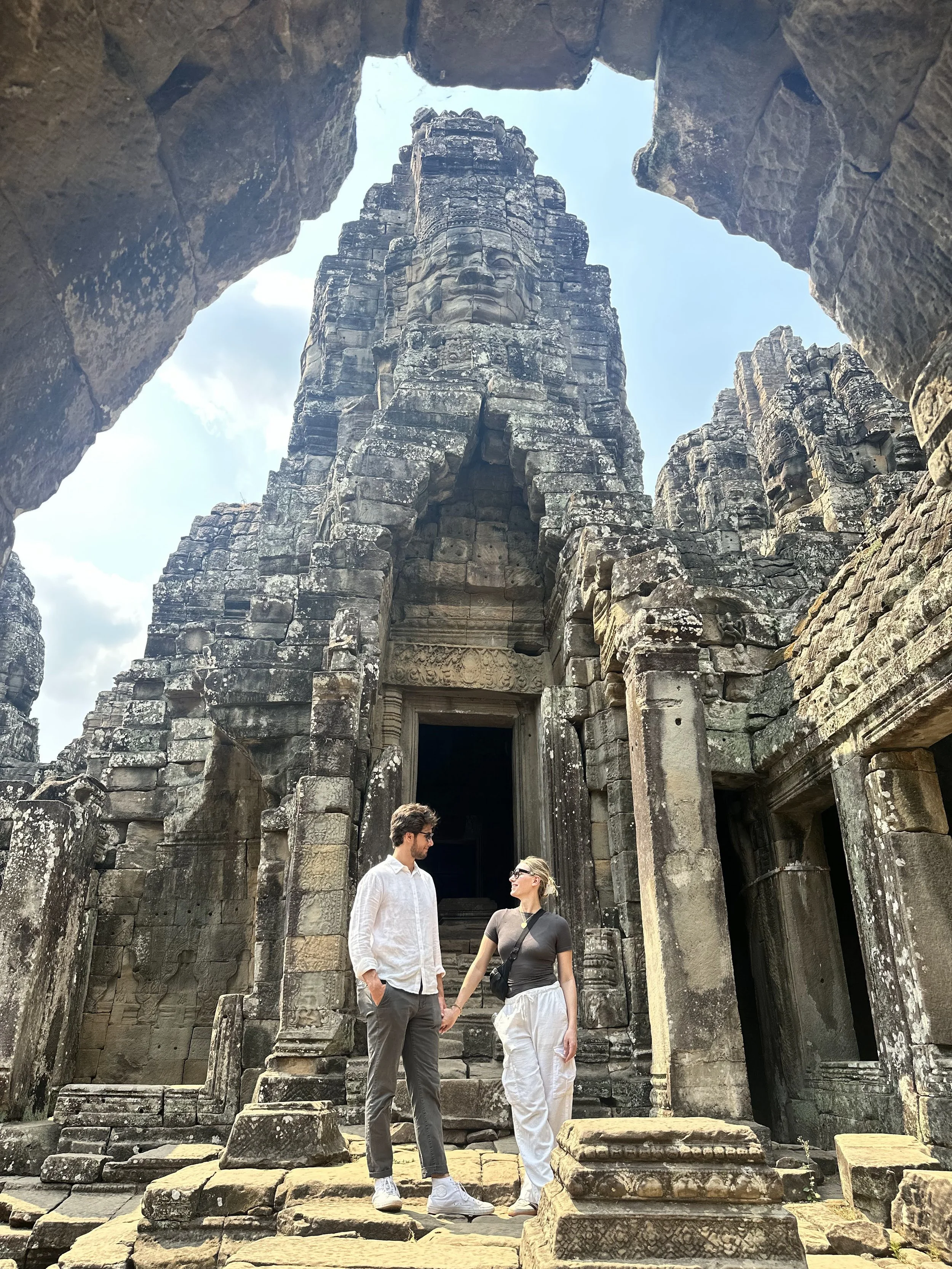
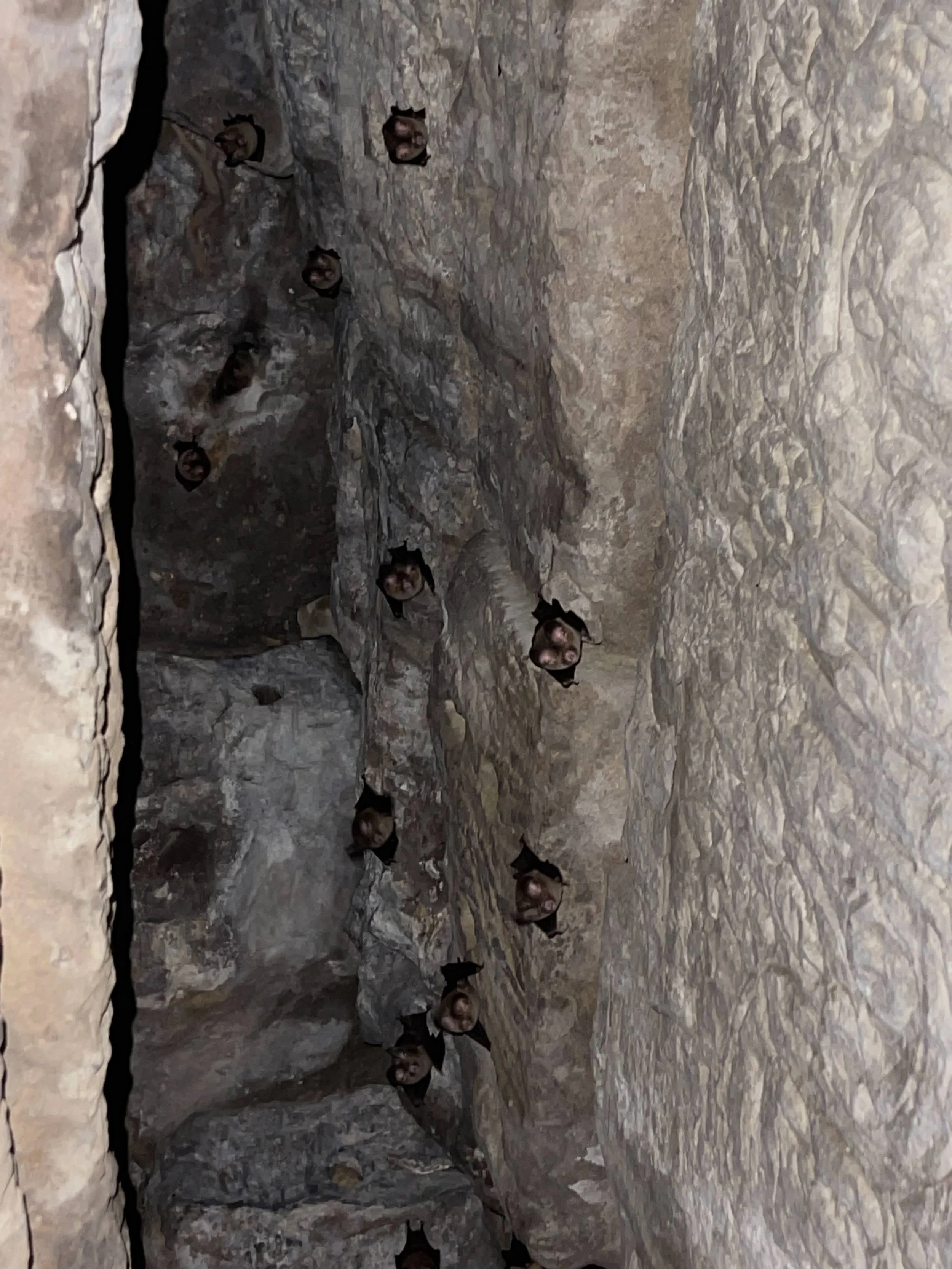
Despite the smiles on the stone faces – or perhaps because of them – this ruin felt far more ominous, more desolate. Bats perched inside its dark depths, chirping to each other as they whittled away the hours until nighttime would return.
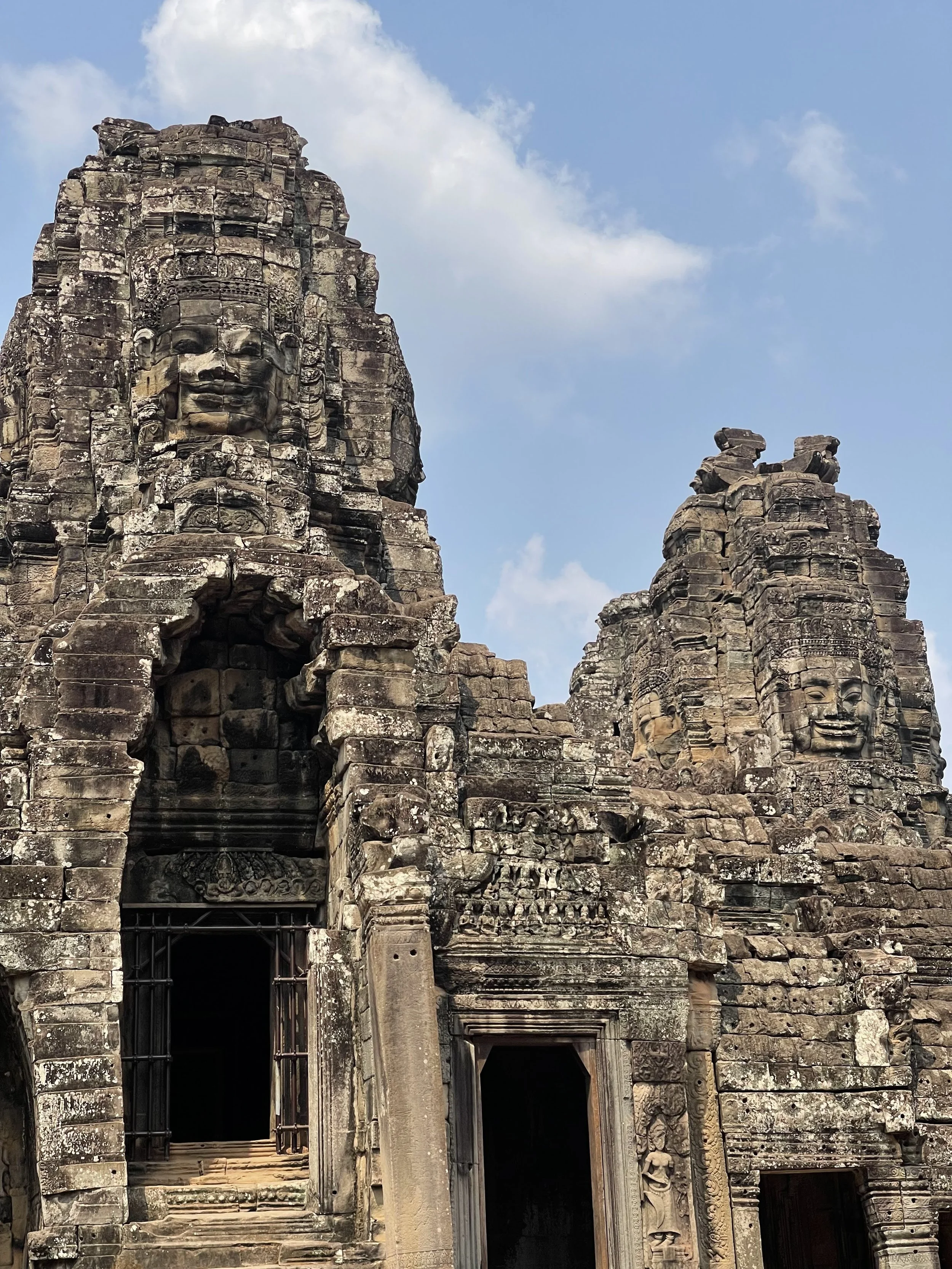
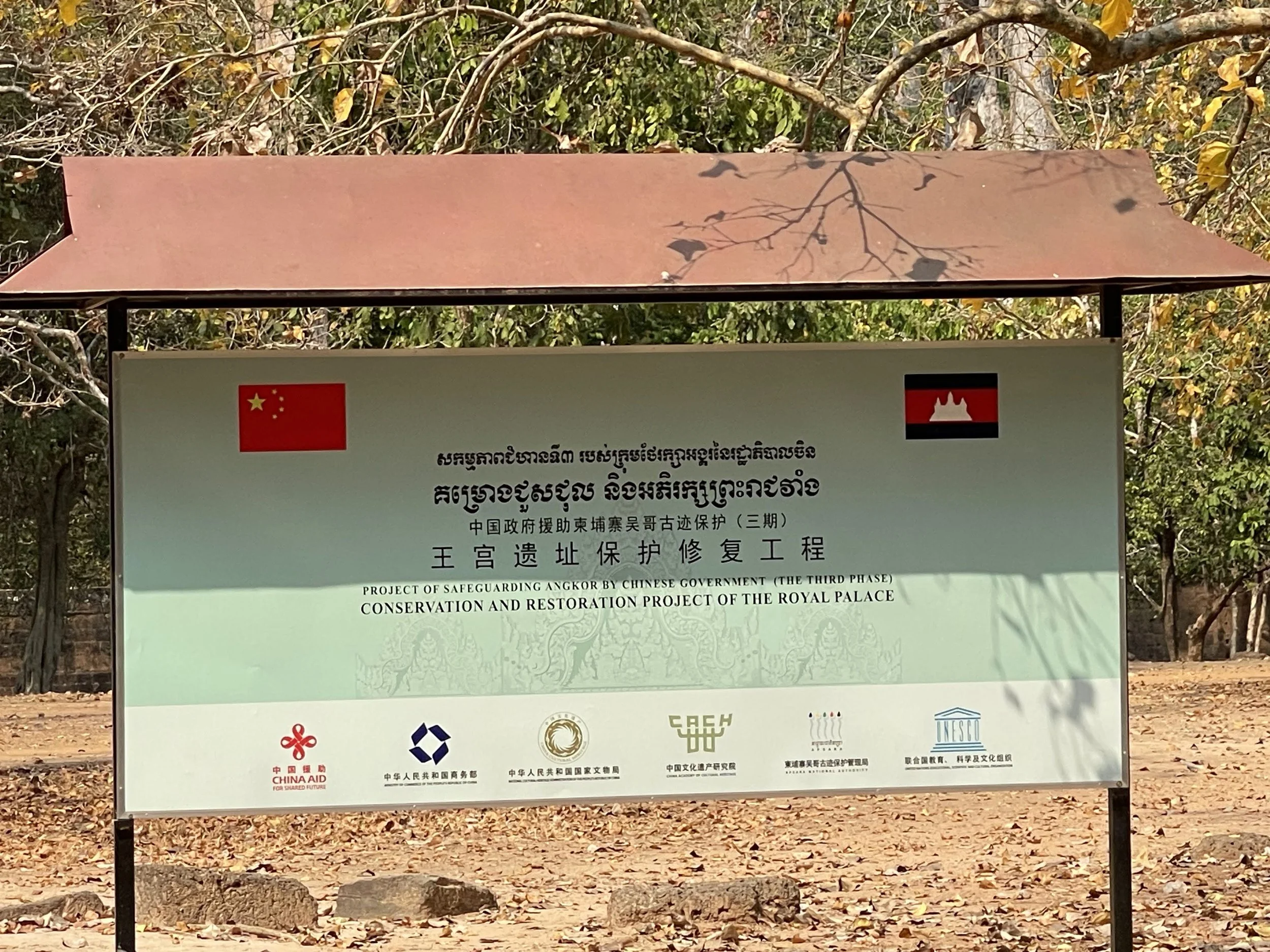
Back outside the temple, life and light reigned again, as workers set up for a concert that would be held outside the temple that evening. I wondered if the Chinese government sponsored the concert, which would only be fitting given the signs we’d seen proclaiming their sponsorship of Angkor conservation and restoration.
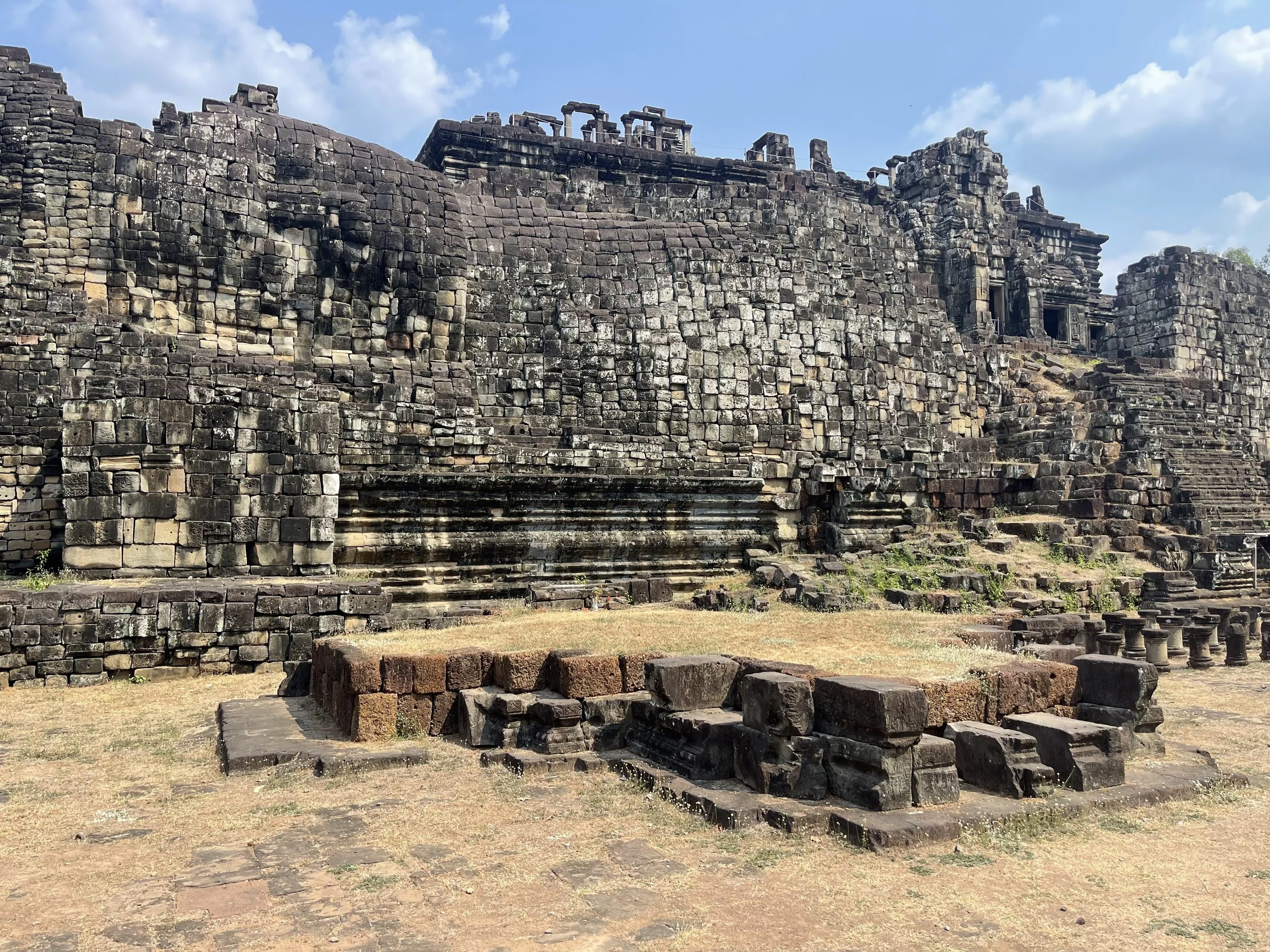
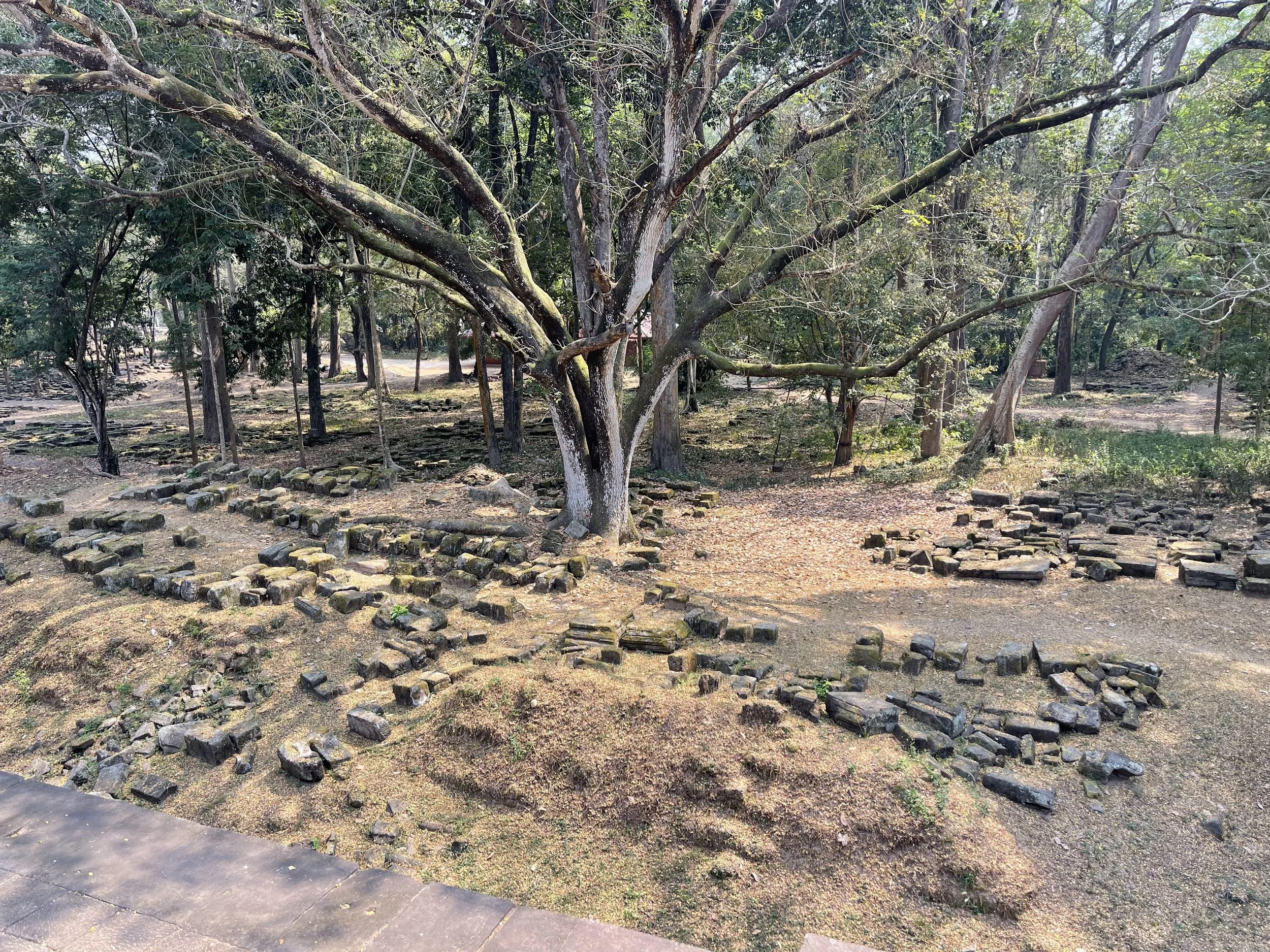
Next we walked to the Baphuon Temple, at which we climbed steps as steep as Angkor Wat’s and enjoyed a nice view of the jigsaws of stone below. At this point, all the walking and climbing in that humidity had started to catch up with us, so we felt relieved when we got to rest in the shade for our viewing of the sleeping stone Buddha.
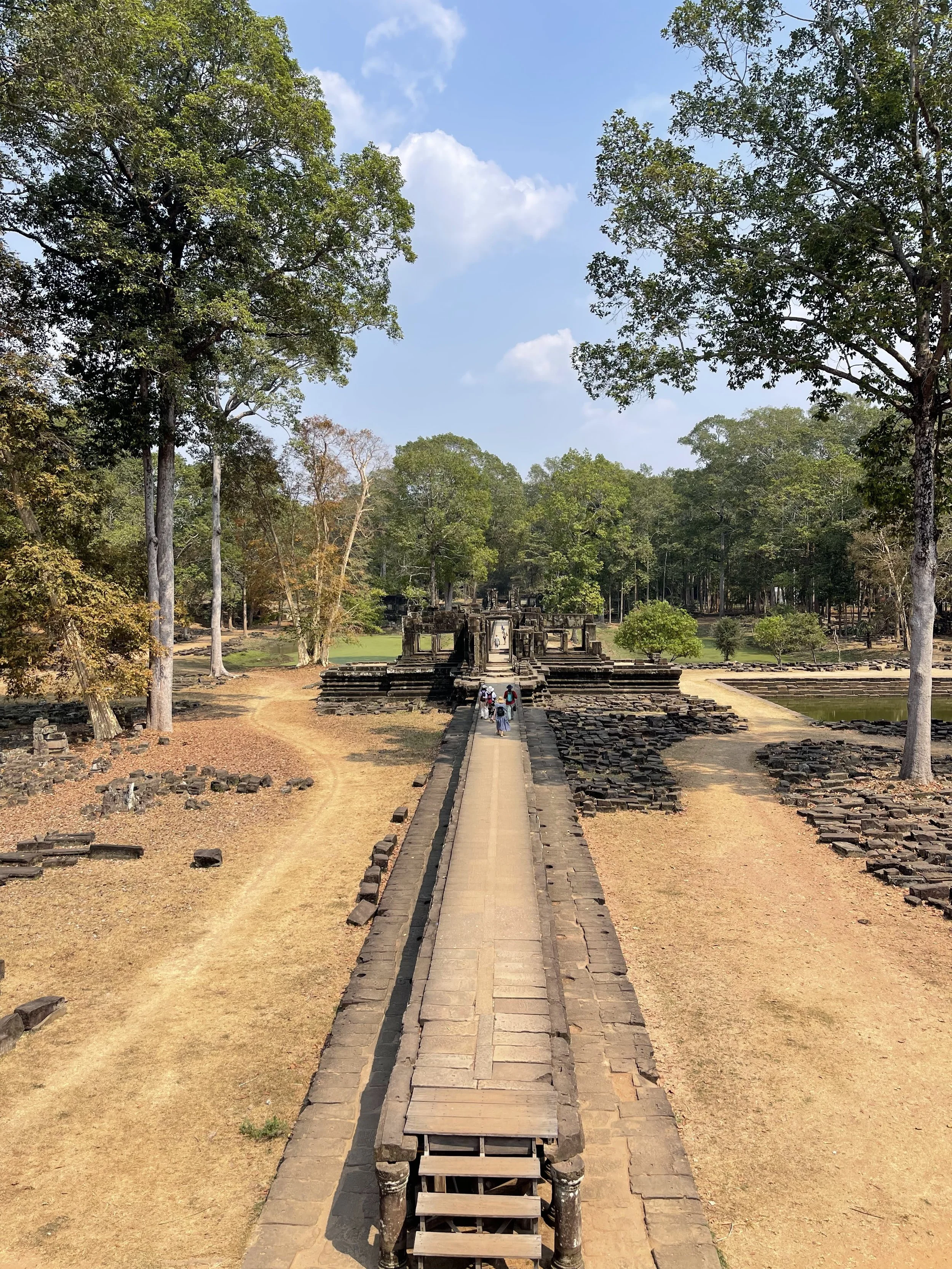
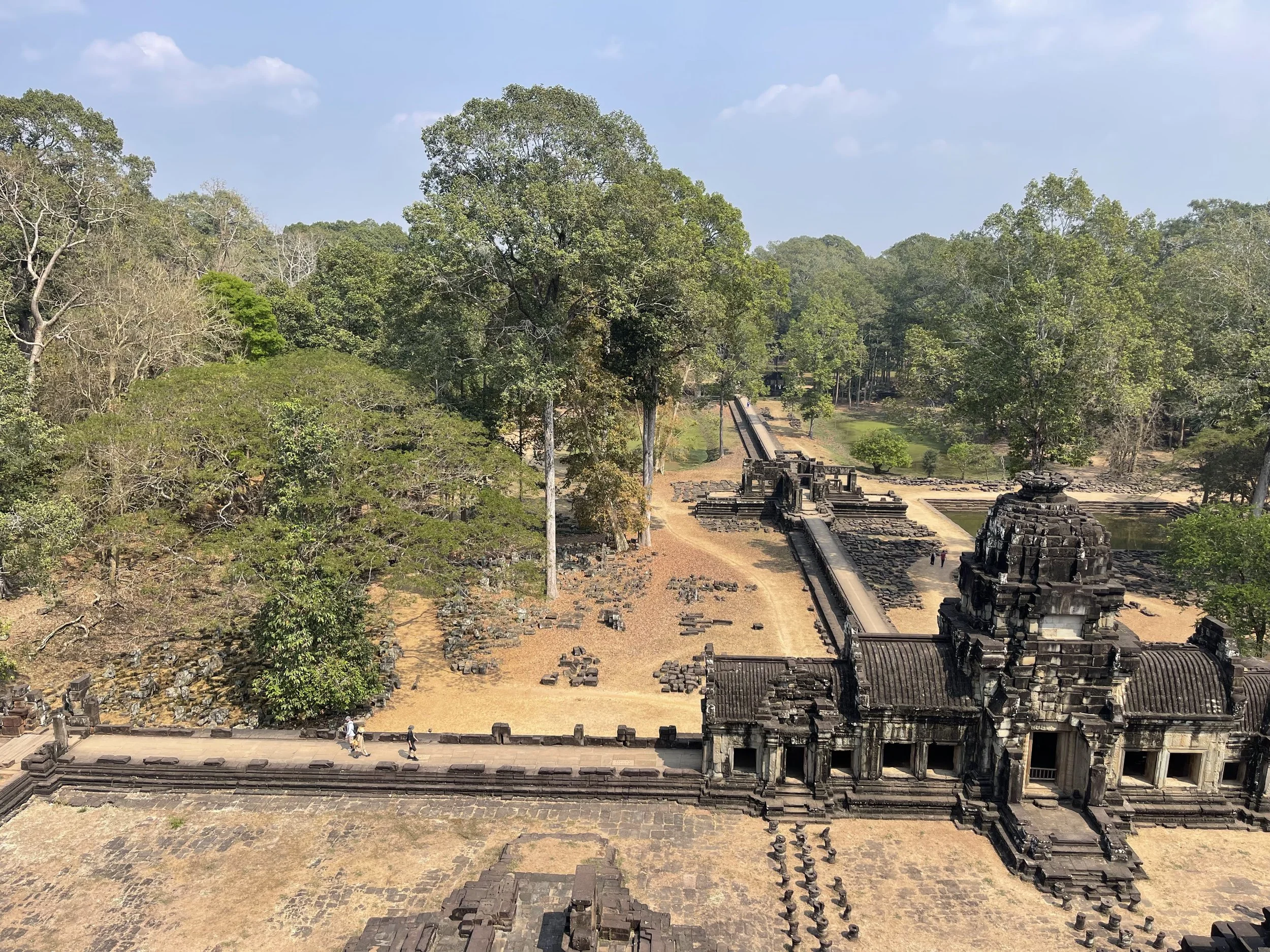
I’d expected our tour would be done by now, having only booked it for the sake of Angkor Wat and barely having skimmed the itinerary. Yet we continued into the sunny Terrace of the Elephants, once used for royal processions, and of course for training people in the handling of those massive mammals.
From there we had to walk through a stone maze in order to make it to our tuk-tuk, into which we collapsed in relief as our driver handed us cold wet towels to wipe the dust off our faces. We sped out of Angkor Thom through the Victory Gate, which took us over a dry moat and towards our final temple of the day.
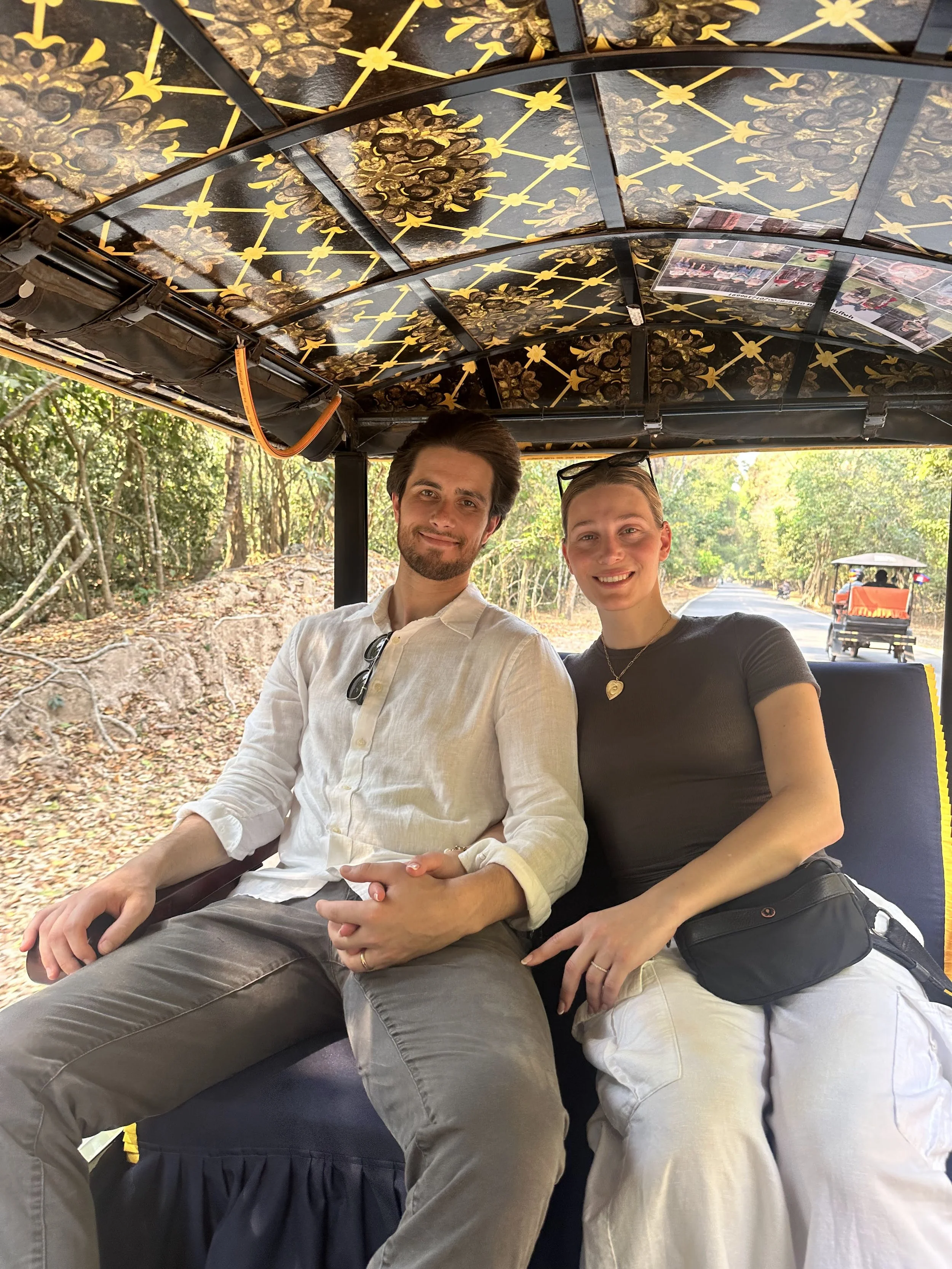
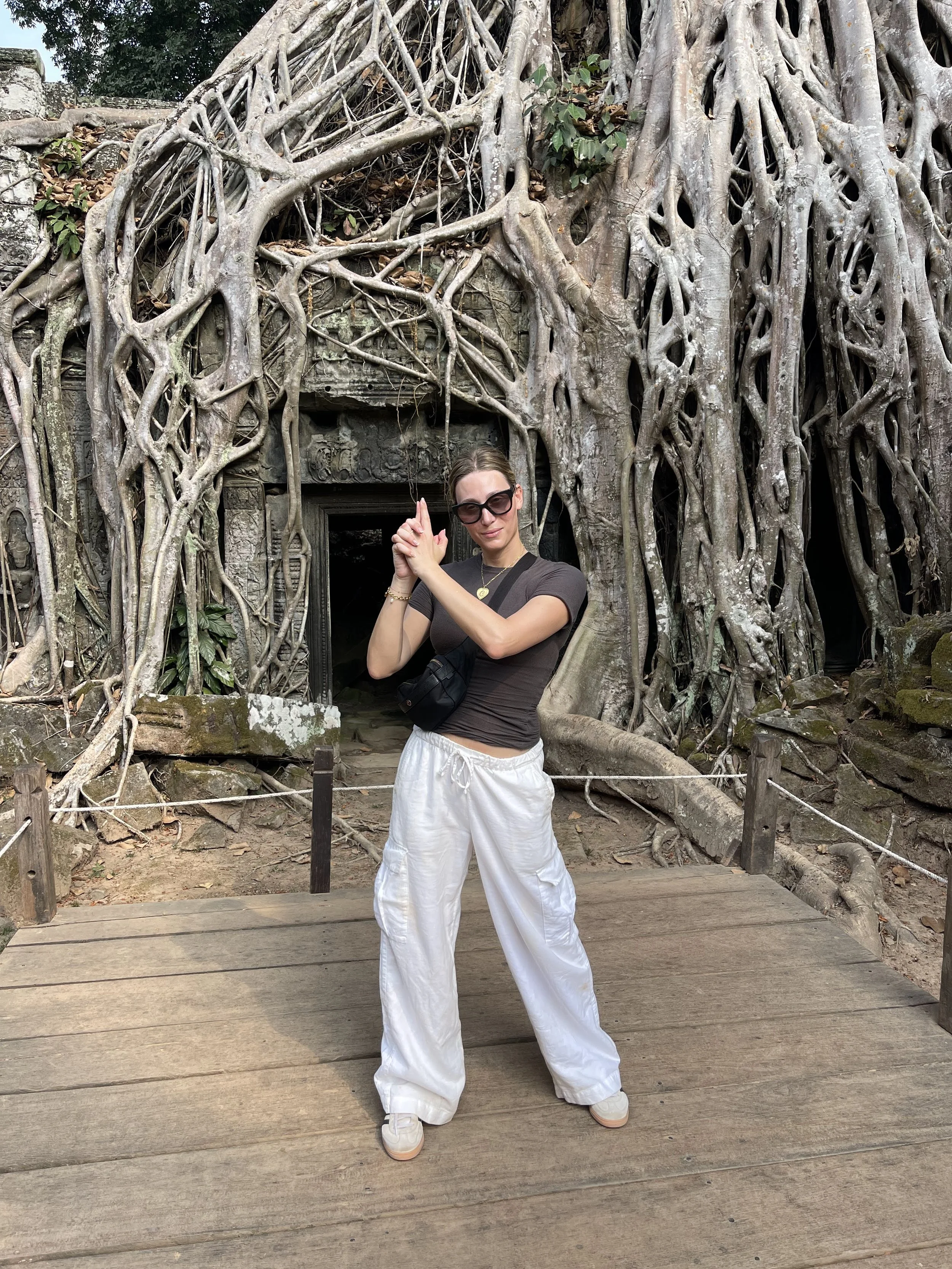
It looked rather unremarkable at first glance, with cranes, scaffolding, and workers surrounding the outside. Yet upon walking in, we couldn’t miss what made this temple unique: the trees growing seamlessly into the stone.
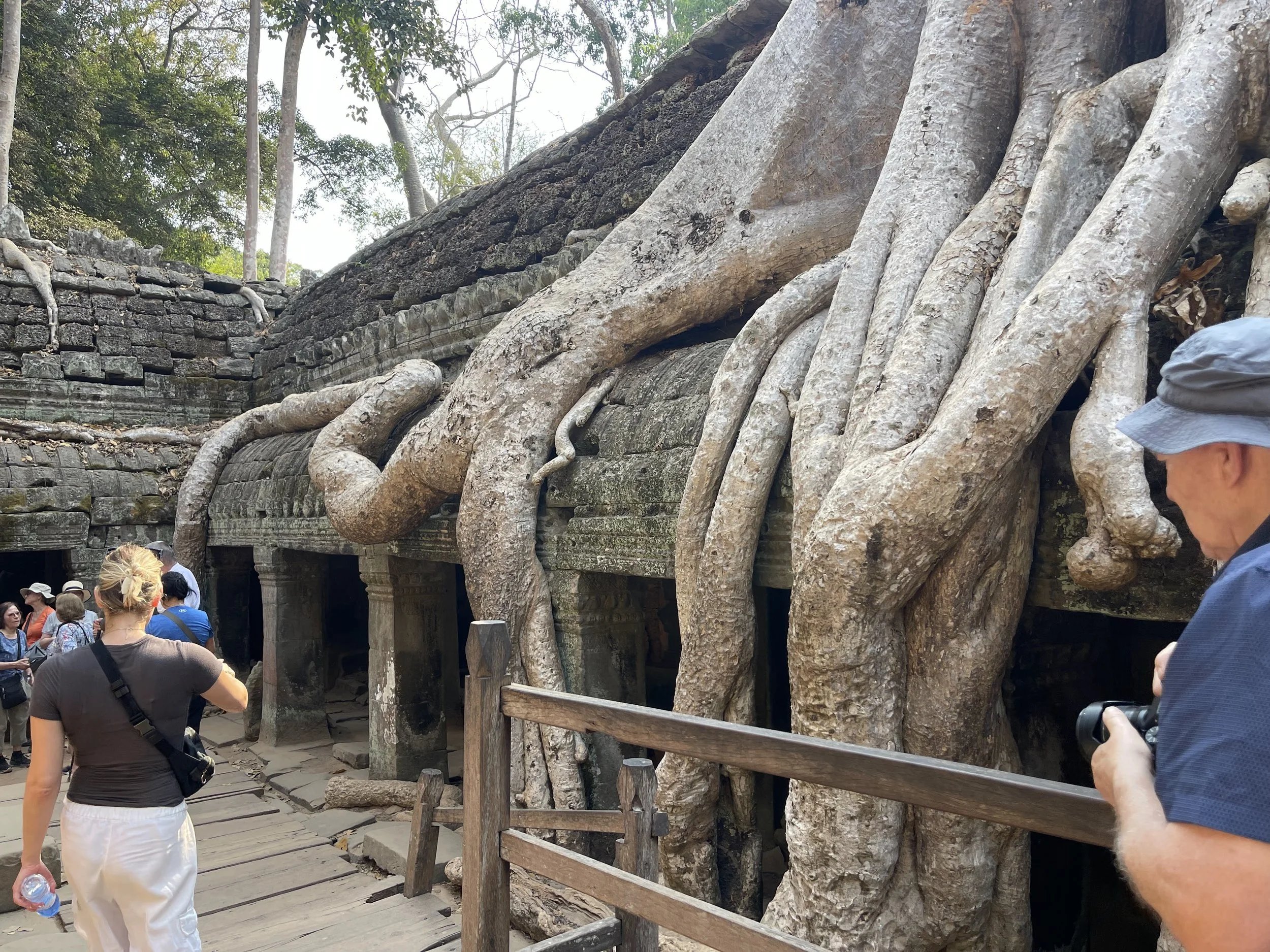
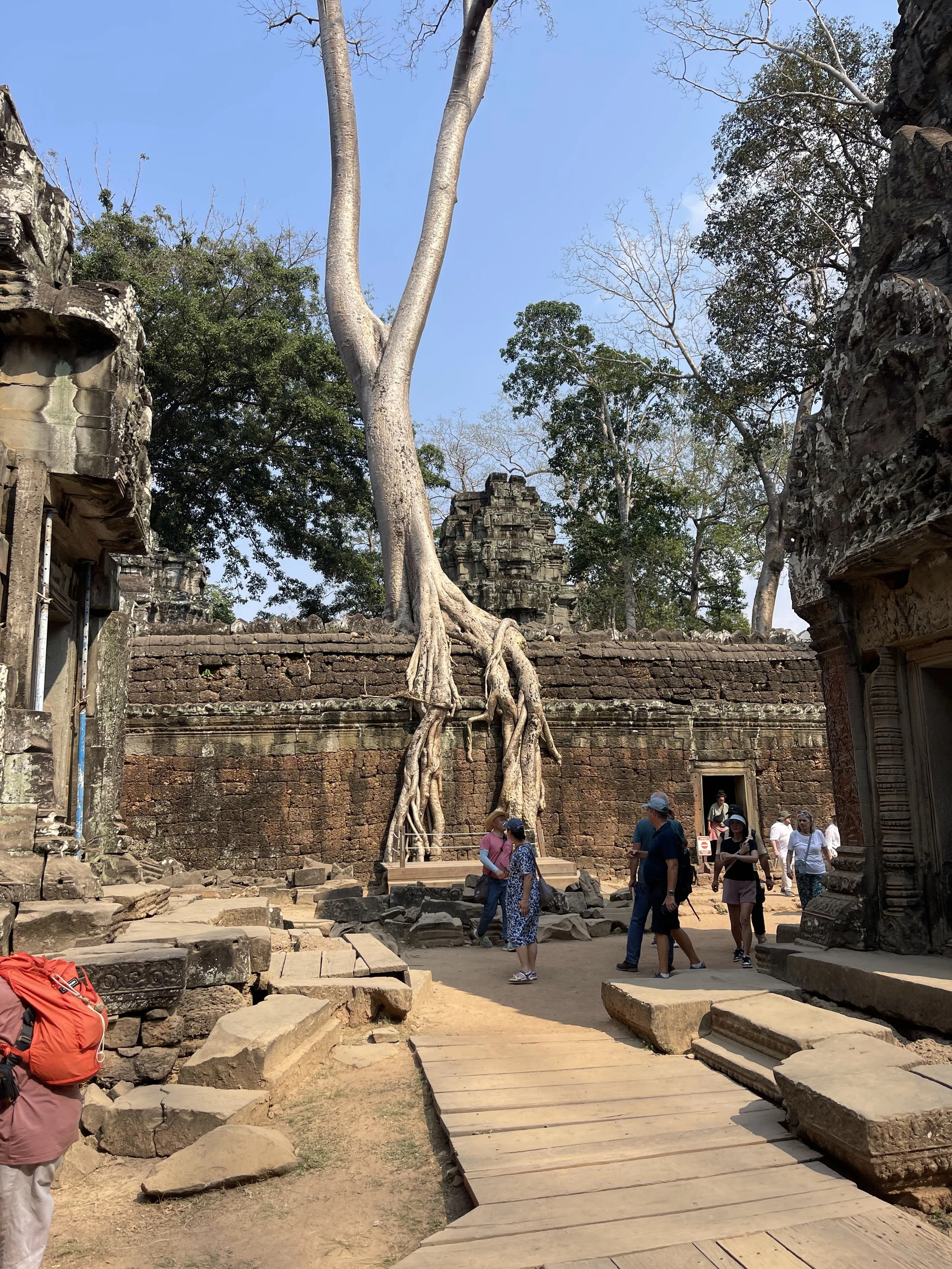
After the original builders had abandoned it, the jungle had reclaimed the temple. Over time, seeds of trees such as the strangler fig germinated on the roofs of the buildings, and from there the roots stretched down in their inexorable search for water, in the process of which they took a firm hold of the buildings that had given them life.
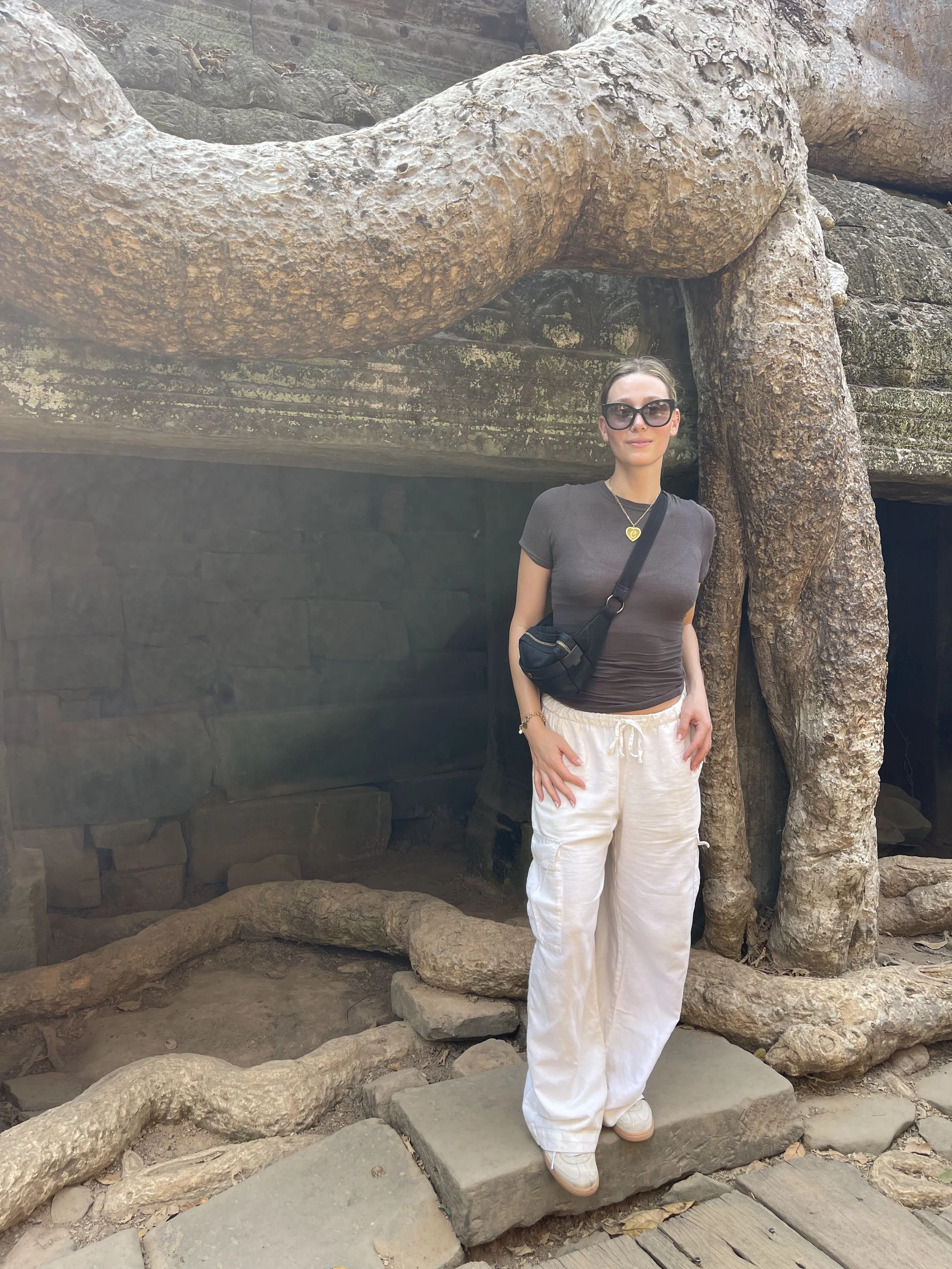
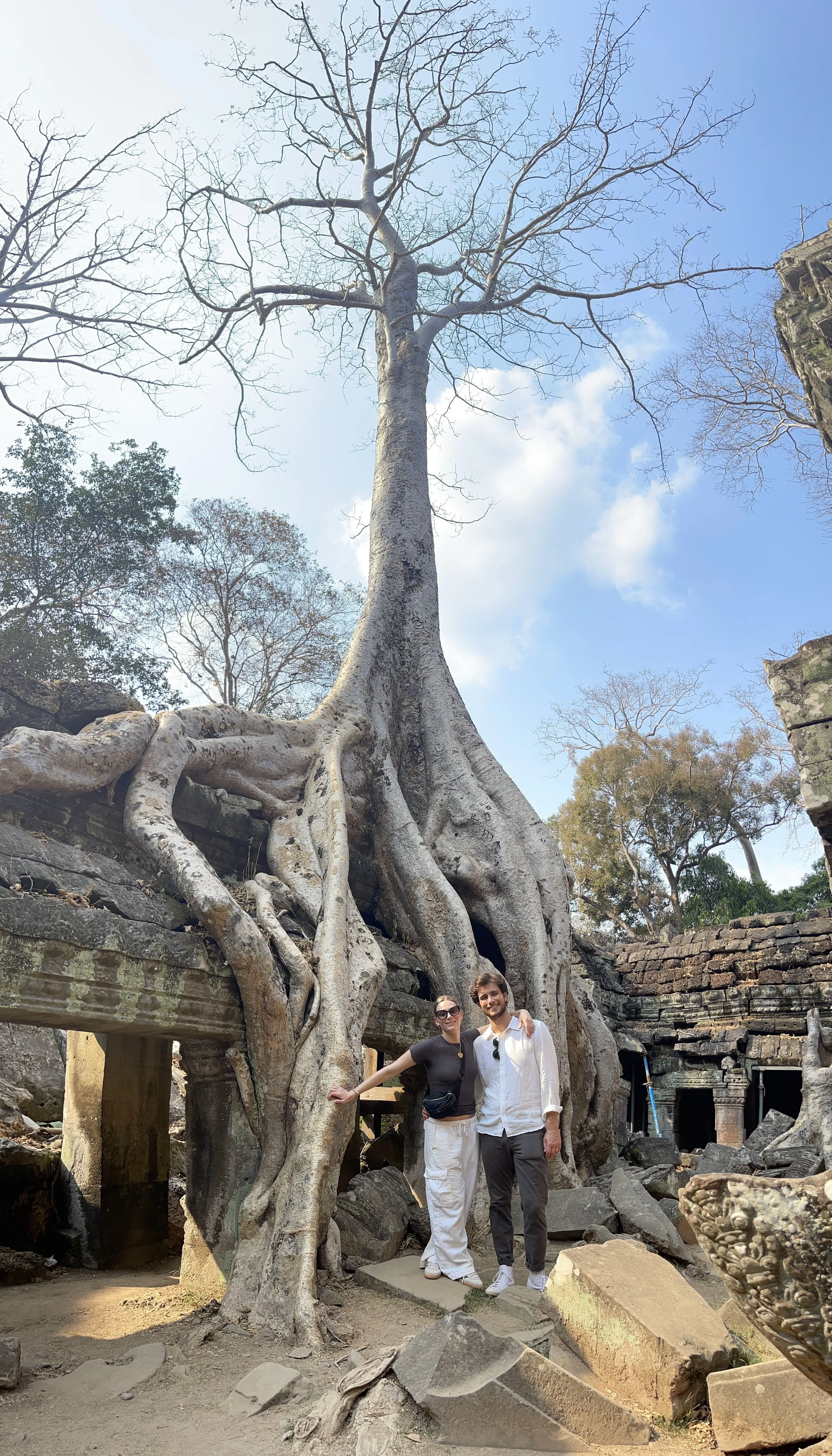
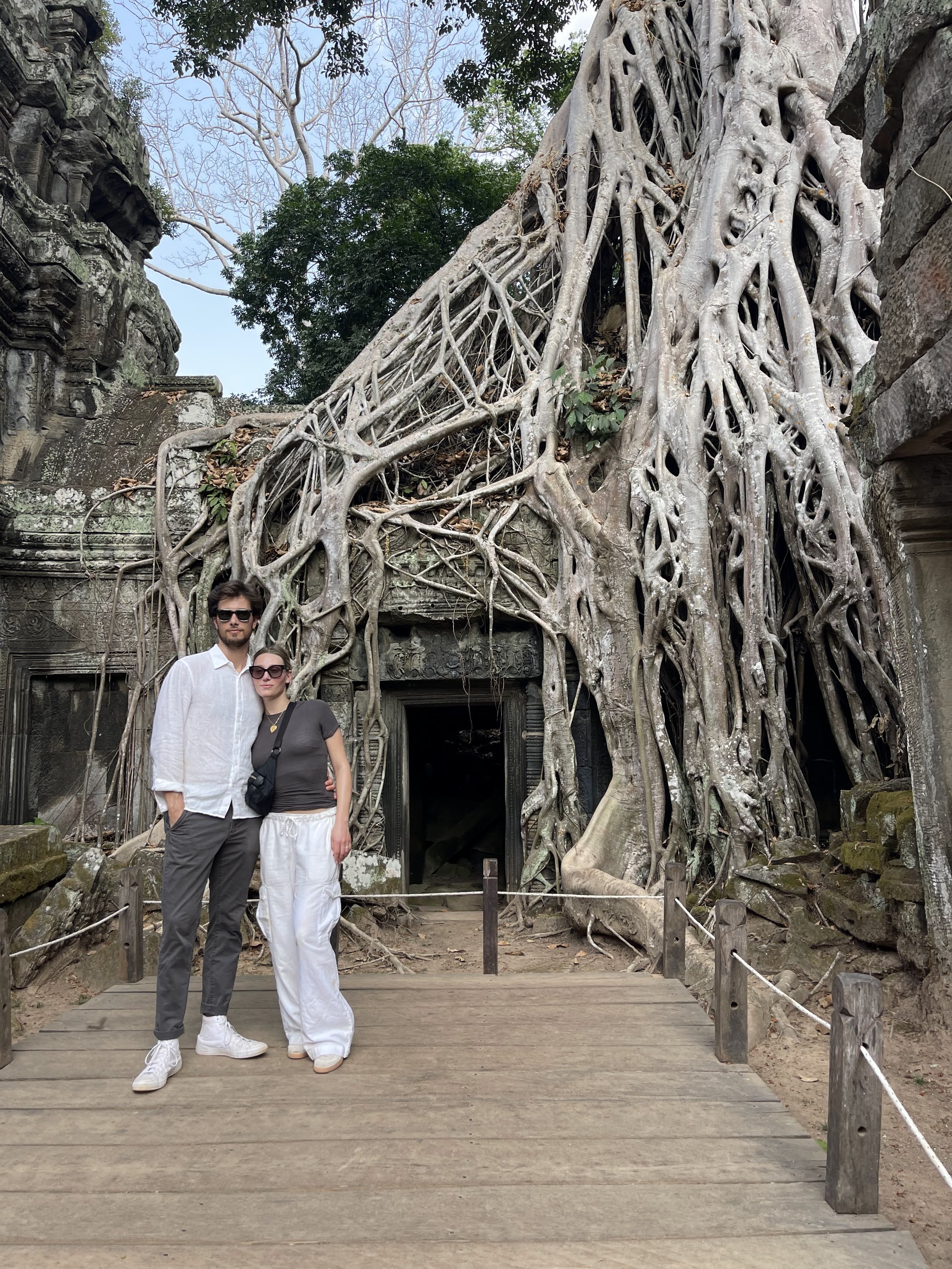
Corey took especial interest in the temple because Angelina Jolie had filmed Tomb Raider here, and according to our guide, Mr. Dong, the part earned her recognition by Cambodians as a national hero.
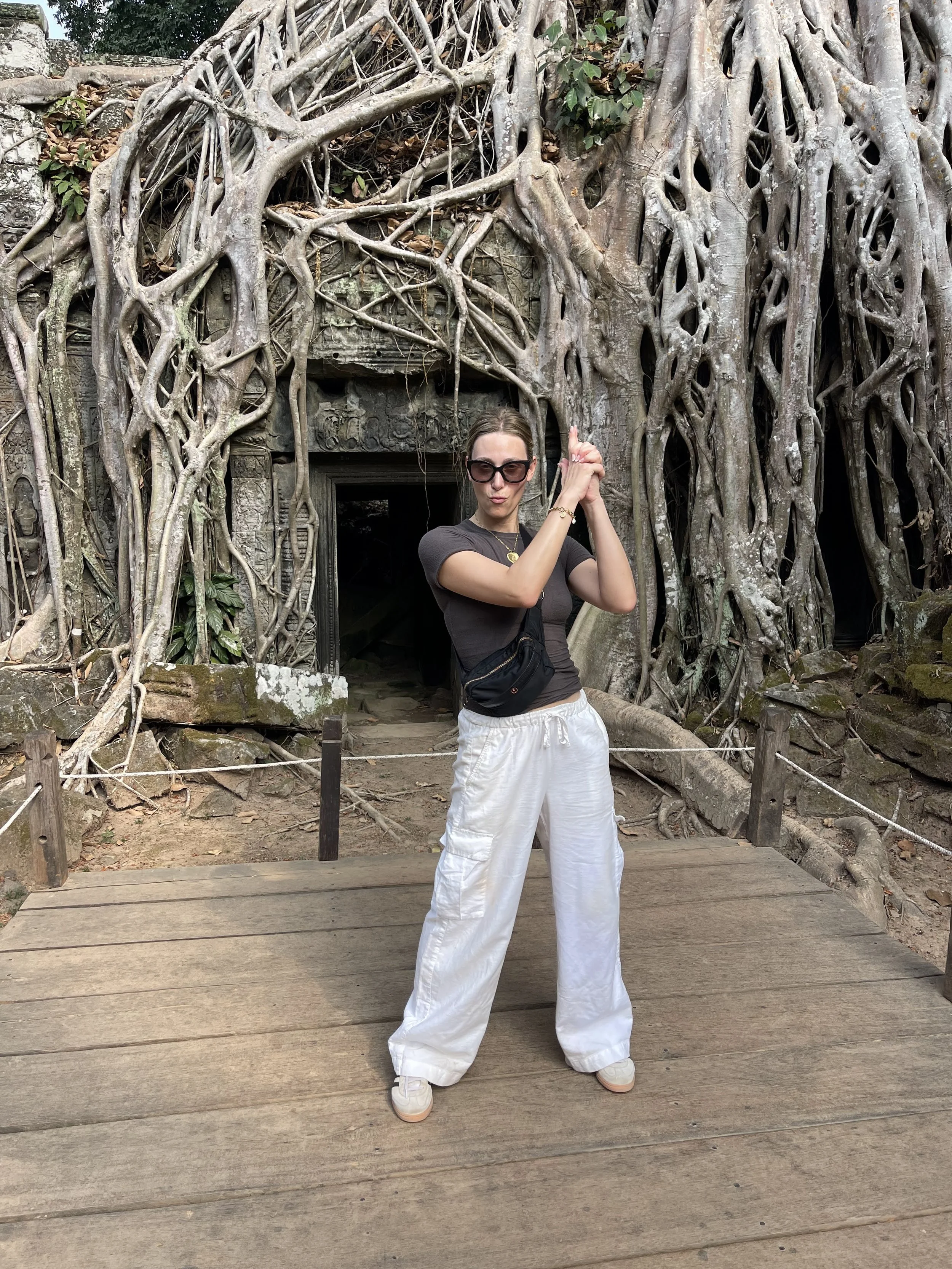
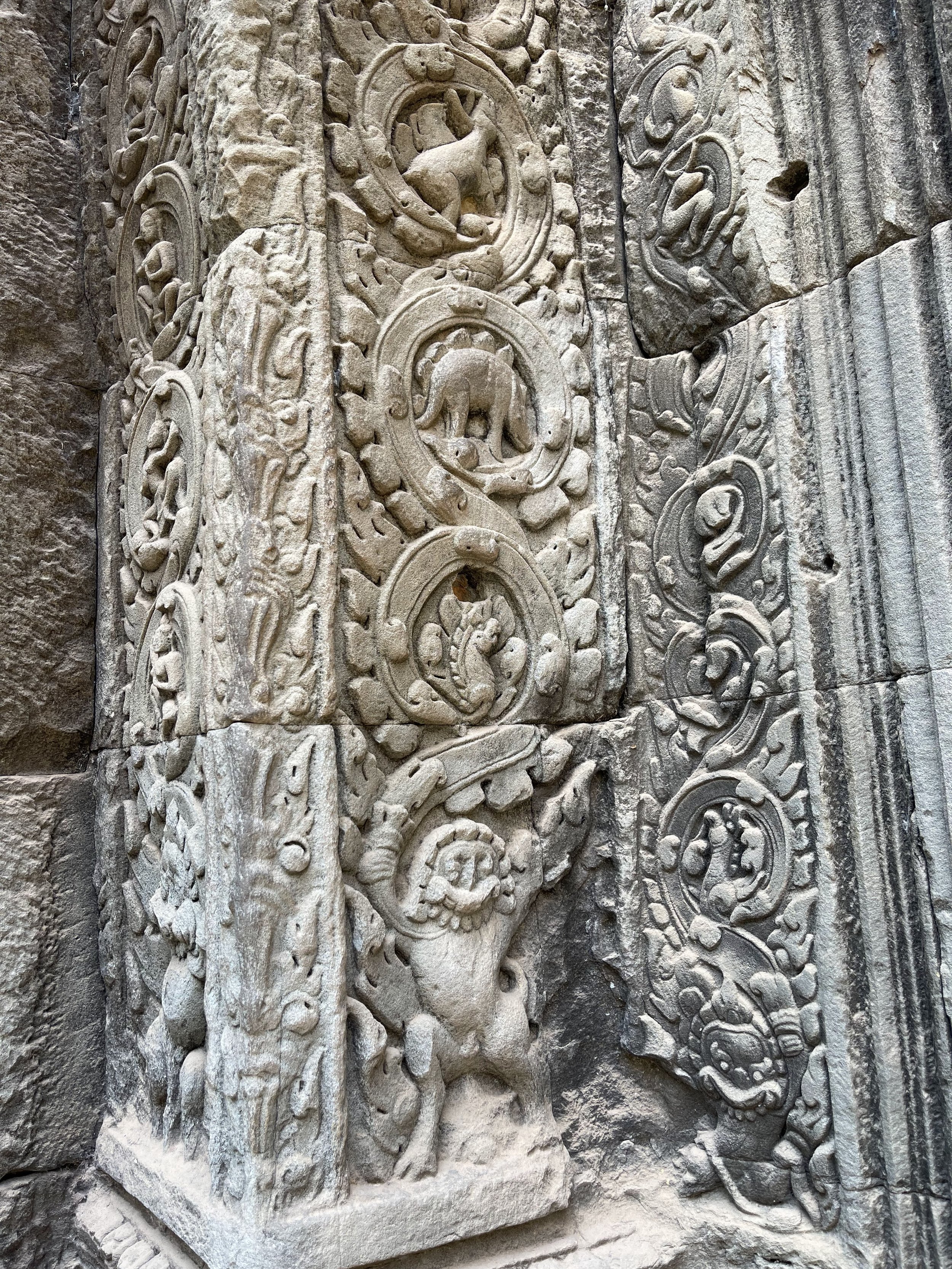
I took especial interest in the Stegosaurus that’s carved into one of its stone corners. While some take this to mean that man coexisted with dinosaurs, there’s no evidence of Stegosaurus fossils in Cambodia, so my best guess is that it’s another figure out of religious mythology. Most experts posit that it’s actually a Sumatran Rhinoceros with the “spikes” actually being leaves in the background.
Completely tired out, we drove back into the city. In the sunlight, we could see that slums lined nearly the entirety of our street, which of course meant that the beautiful walls of our resort looked rather out of place, no matter how much the builders had tried to style them in the traditional Khmer manner.
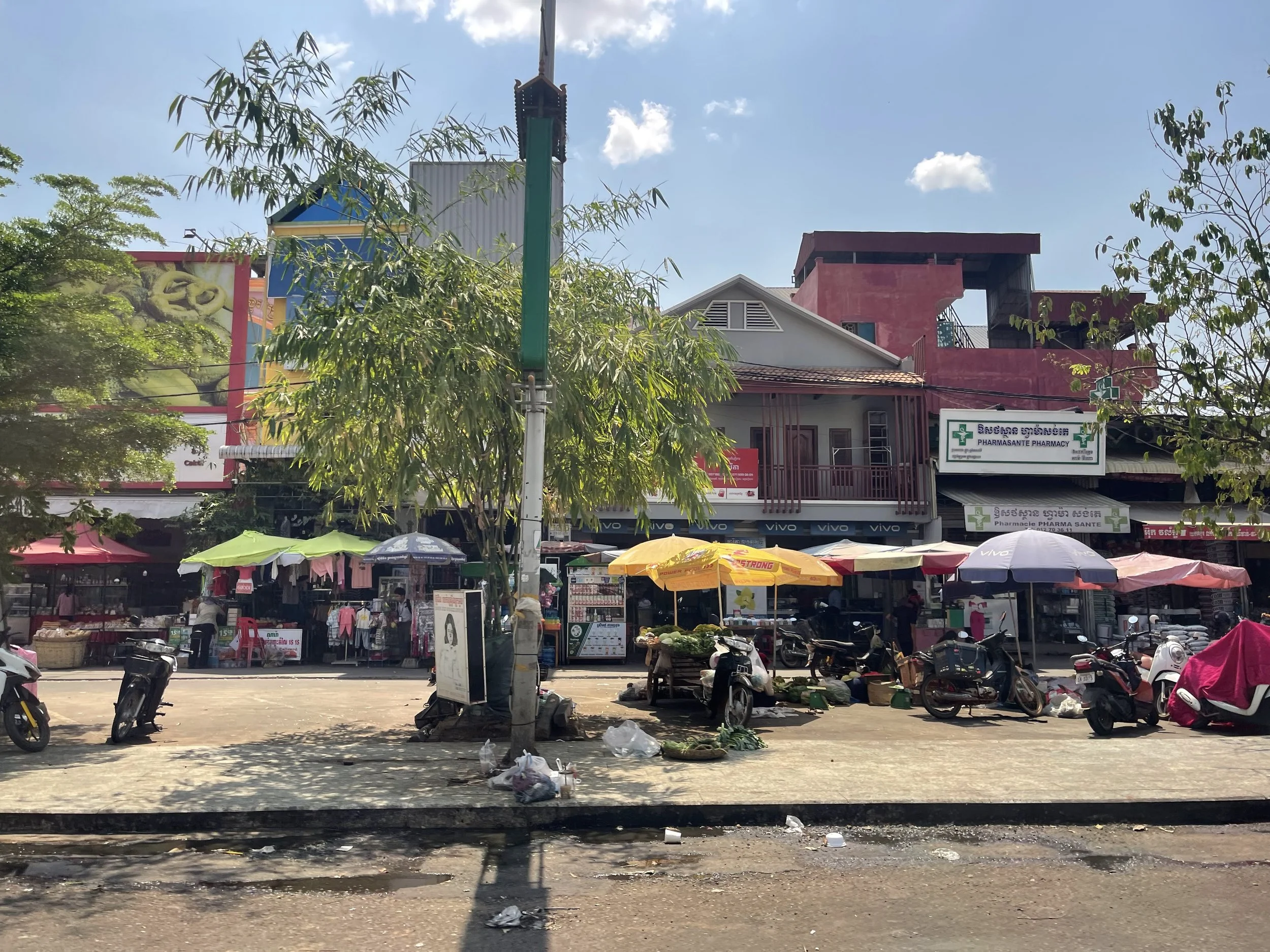
The view outside our little bubble
Before we bid farewell to Mr. Dong, he told us how he’d grown up in Siem Reap — hopefully after the days of Pol Pot, though I felt too shy to ask — and how most locals end up living in the rural areas, whereas most city dwellers came from other provinces, primarily to work in tourism — by far the largest industry in Siem Reap. Yet it’s been slower since covid, and even as of our visit in 2025 hadn’t fully picked back up. Of all tourism workers we met over our ten months abroad, he and the other Cambodians seemed genuinely the most grateful for our business. I tipped him over a hundred thousand KHR — more than appropriate given our tour cost – though it took me a sec to do the mental math in multiplying and dividing by 4000 to figure out the cost in USD. Each time I worried that I’d missed a zero and had paid either far too extravagantly or miserly.
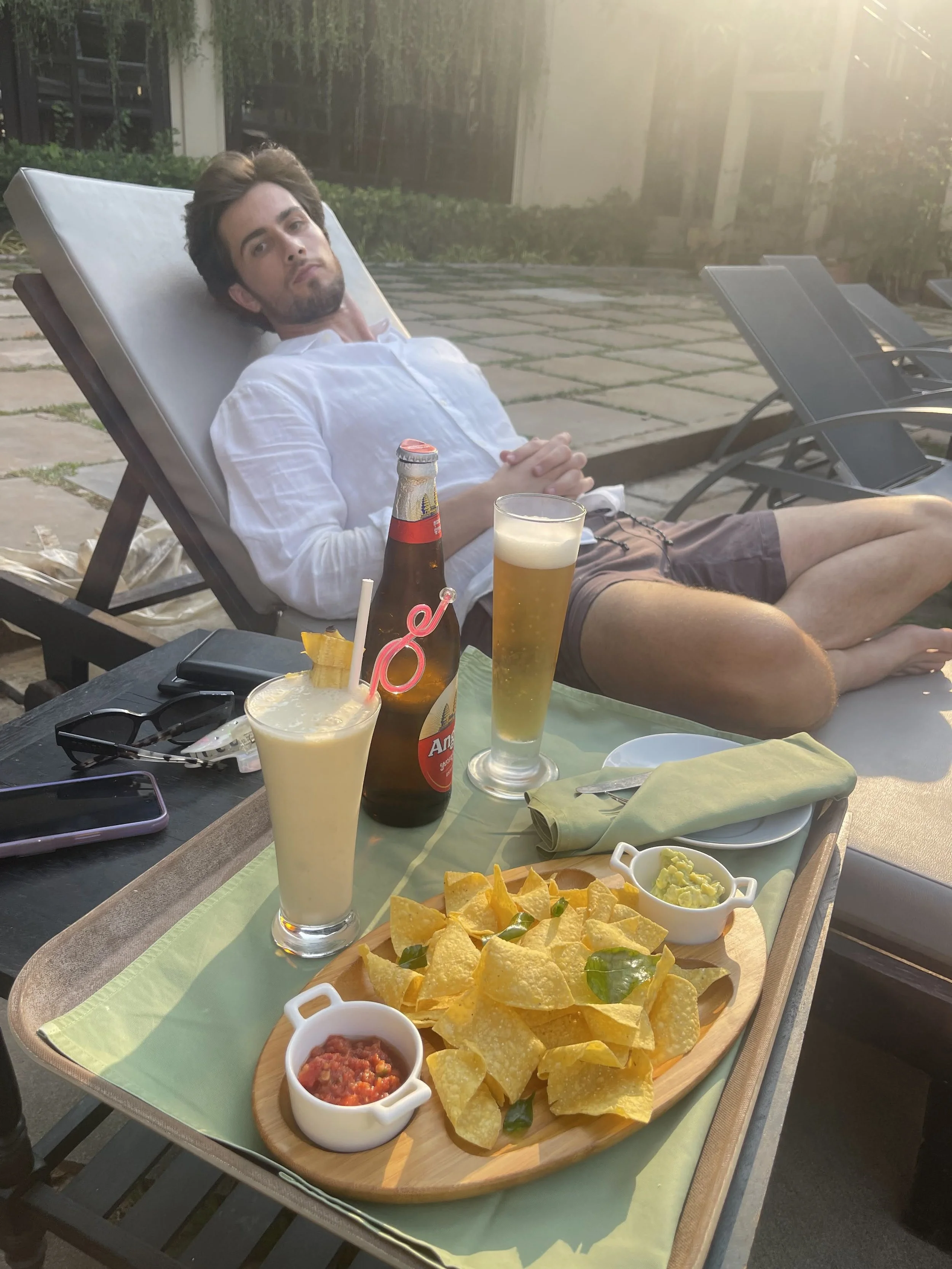
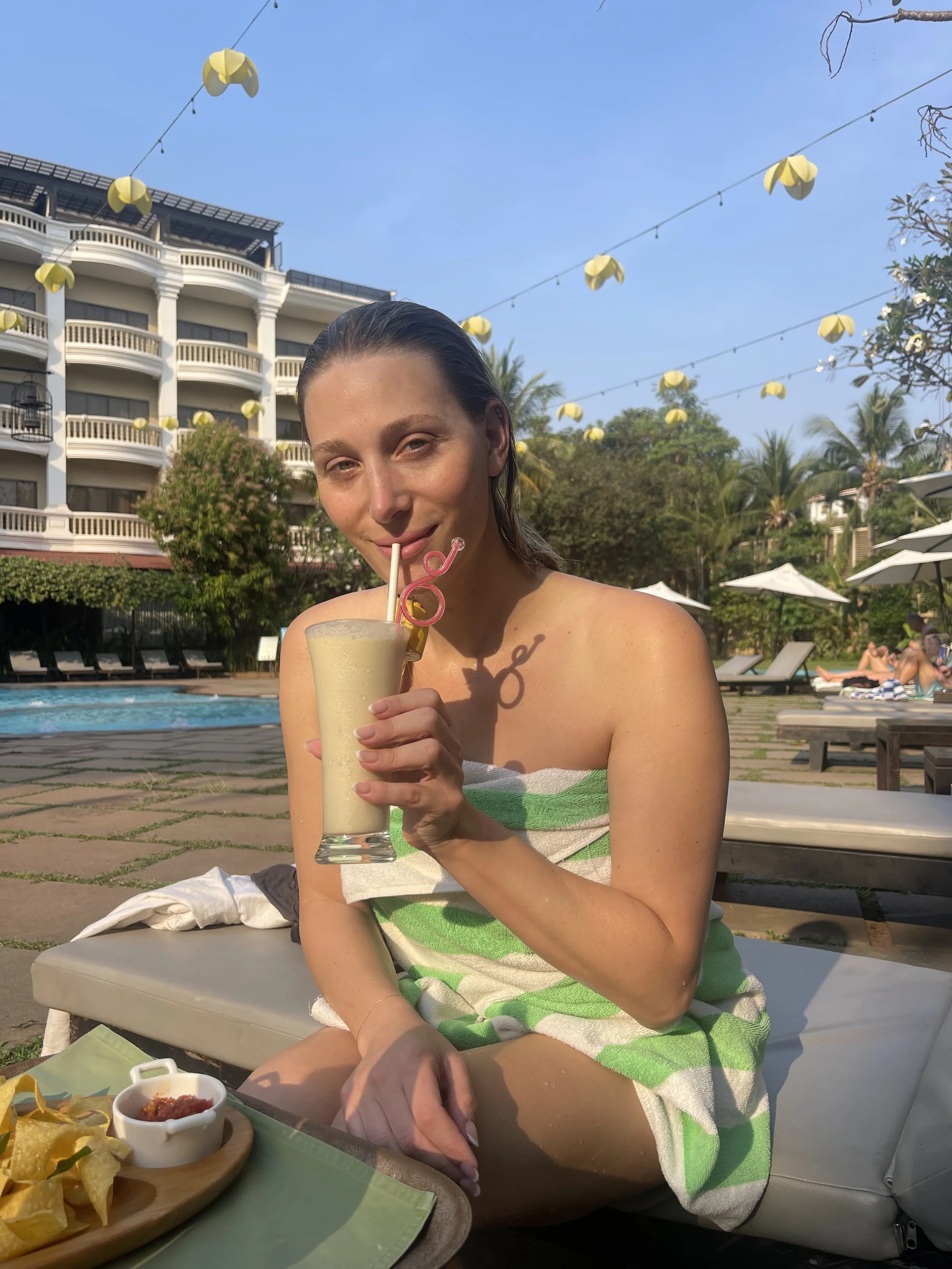
Corey & I watched the sun set by the pool, where we snacked on chips and I drank a large Angkor beer, having gotten over my stomach bug just in time to put it to good use. That night happened to be a Tuesday, one of the three nights on which the resort puts on a “culture night” dinner and show; tired from our long day in the heat we figured that made more sense than venturing outside our luxurious enclave.
After getting dressed, we waited in the lobby for the festivities to commence. First a trickle of people joined us, and then a large group of about 20 Americans, all around our age or a little younger. From chatting with one of the women, Corey learned that they’re a group of Christian missionaries, having just concluded a long day not of temple-hopping but rather of proselytizing.
Once the entire group of around 50 had arrived, hotel staff led us outside; after passing through a tree-lined walkway, we emerged into a full re-creation of a rustic Cambodian village.
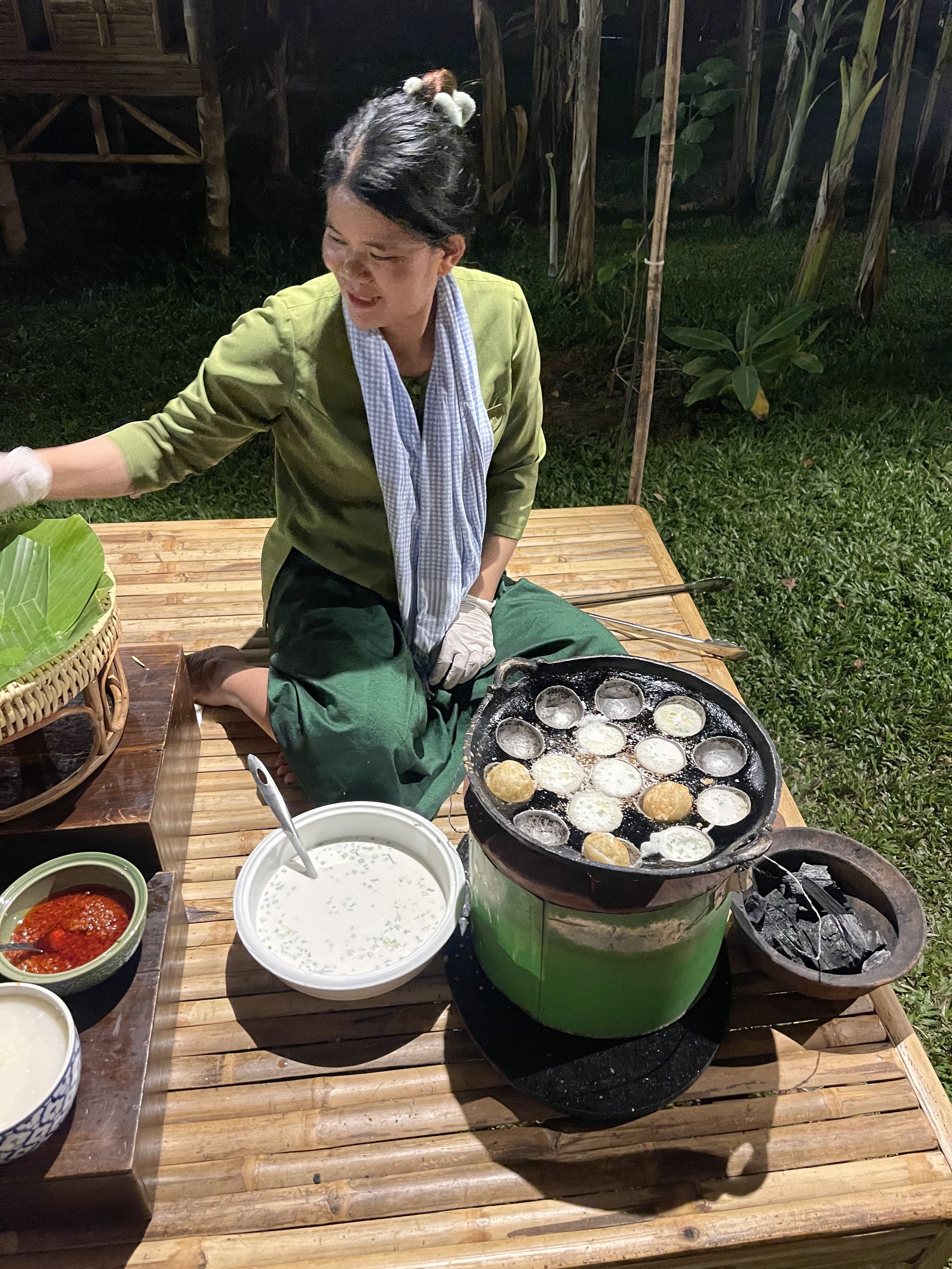
Throughout the staged village scene, resort employees engaged in occupations both practical – cooking appetizers – and performative – folding lotus flowers, casting fishing nets, and reeling silk.
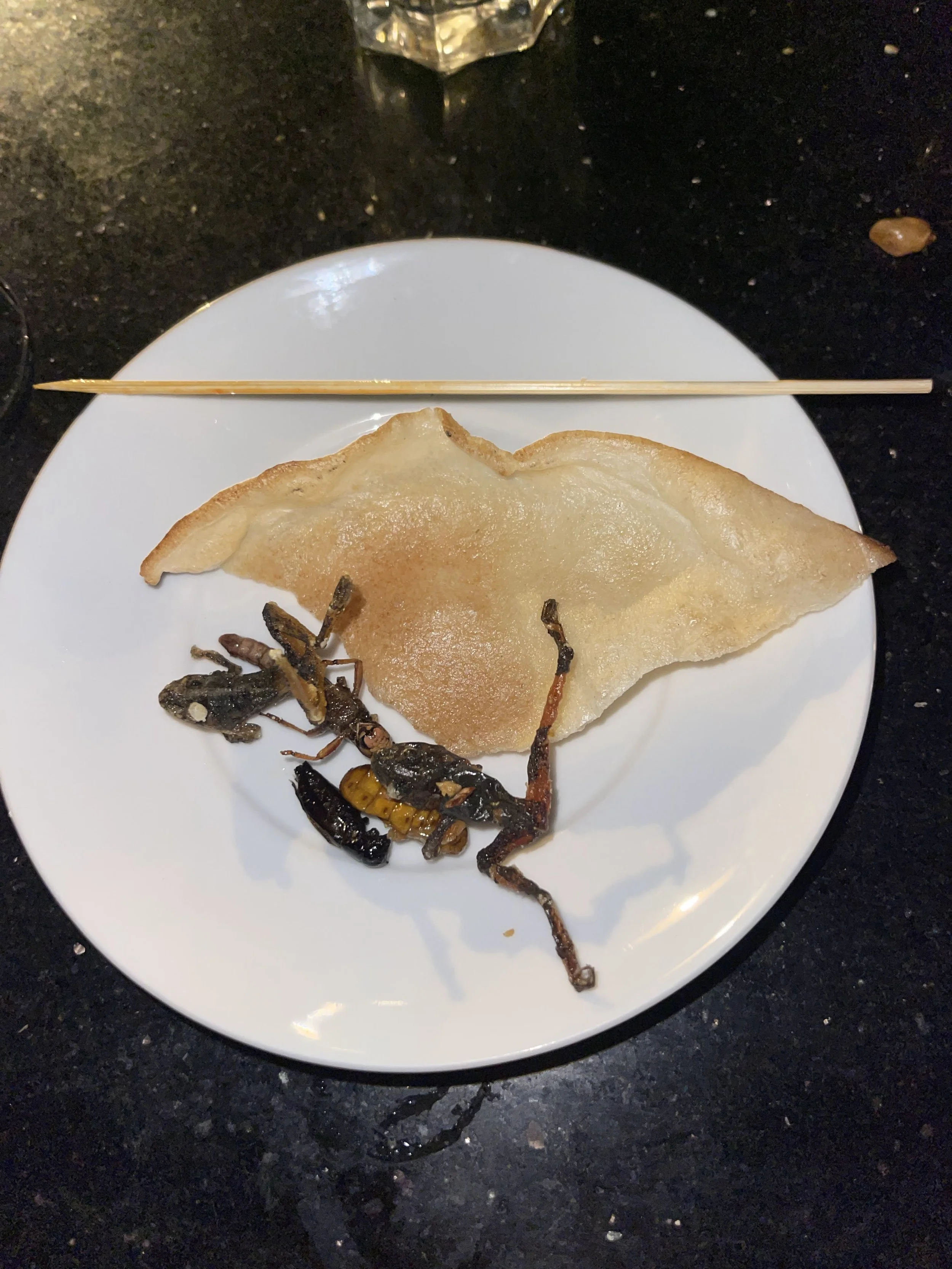
As for those appetizers, Corey & I agreed on the nom kruok, essentially a bite-sized pancake, as the tastiest one — decidedly more delicious than the ambok (or dried rice). My wife did not join me in sampling their selection of insects: water beetles, crickets, grasshoppers, silkworms, and tarantulas. Nor for the rice field frog or the watermelon balls topped with dry fish shavings. Besides the nom kruok, I filled up mostly on beef skewers and crispy fried shrimp, attempting to make up for my missed lunch.
The main event kicked off with not a national anthem but a peacock dance, after which we sat for dinner in front of a pavilion stage. The night hadn’t done away with the humidity, so Corey stayed cool by fanning herself with our menus.
Then the lights winked off and after a few moments, candles lit on stage, revealing our servers holding our first course of lotus salad.
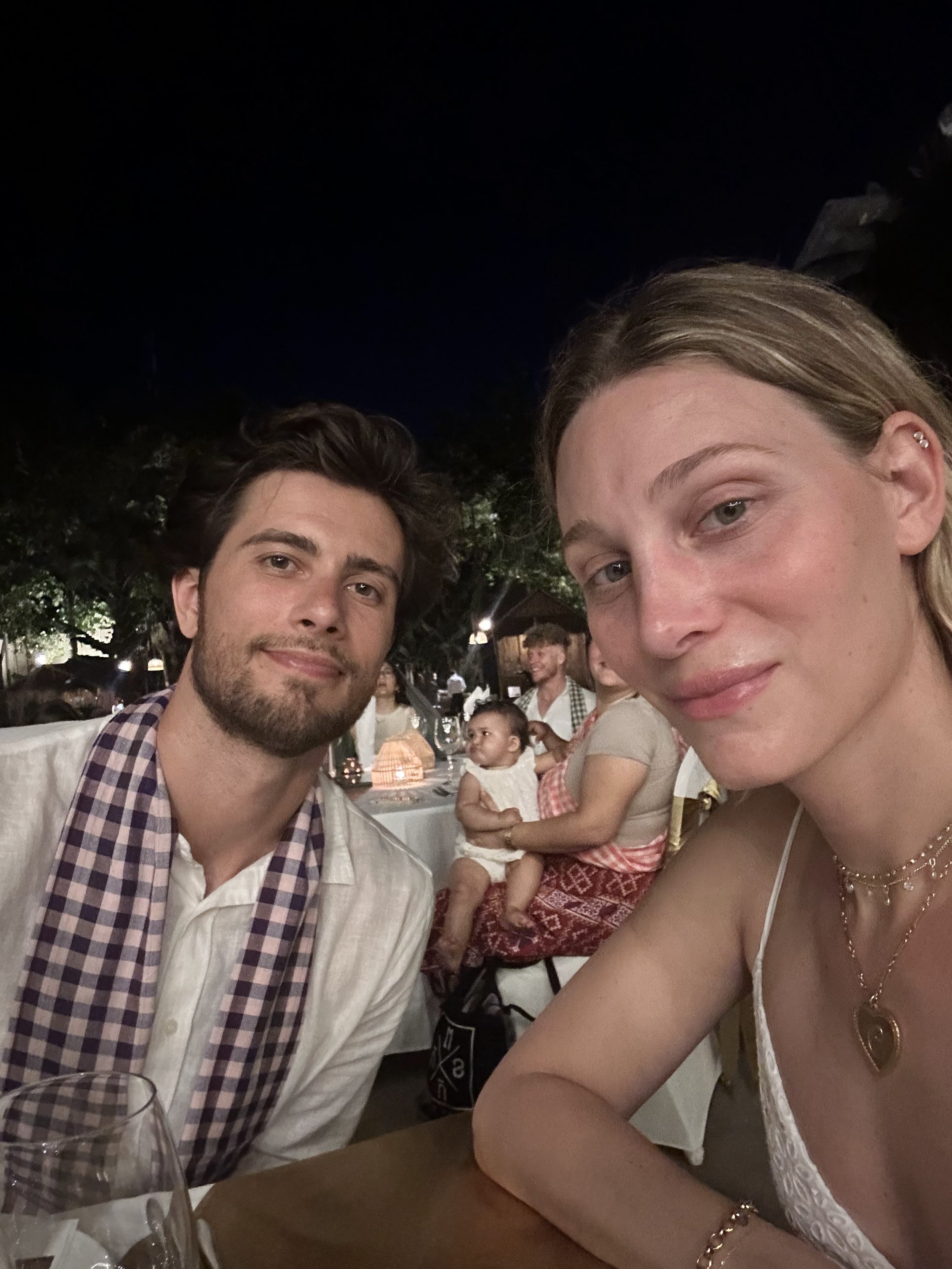
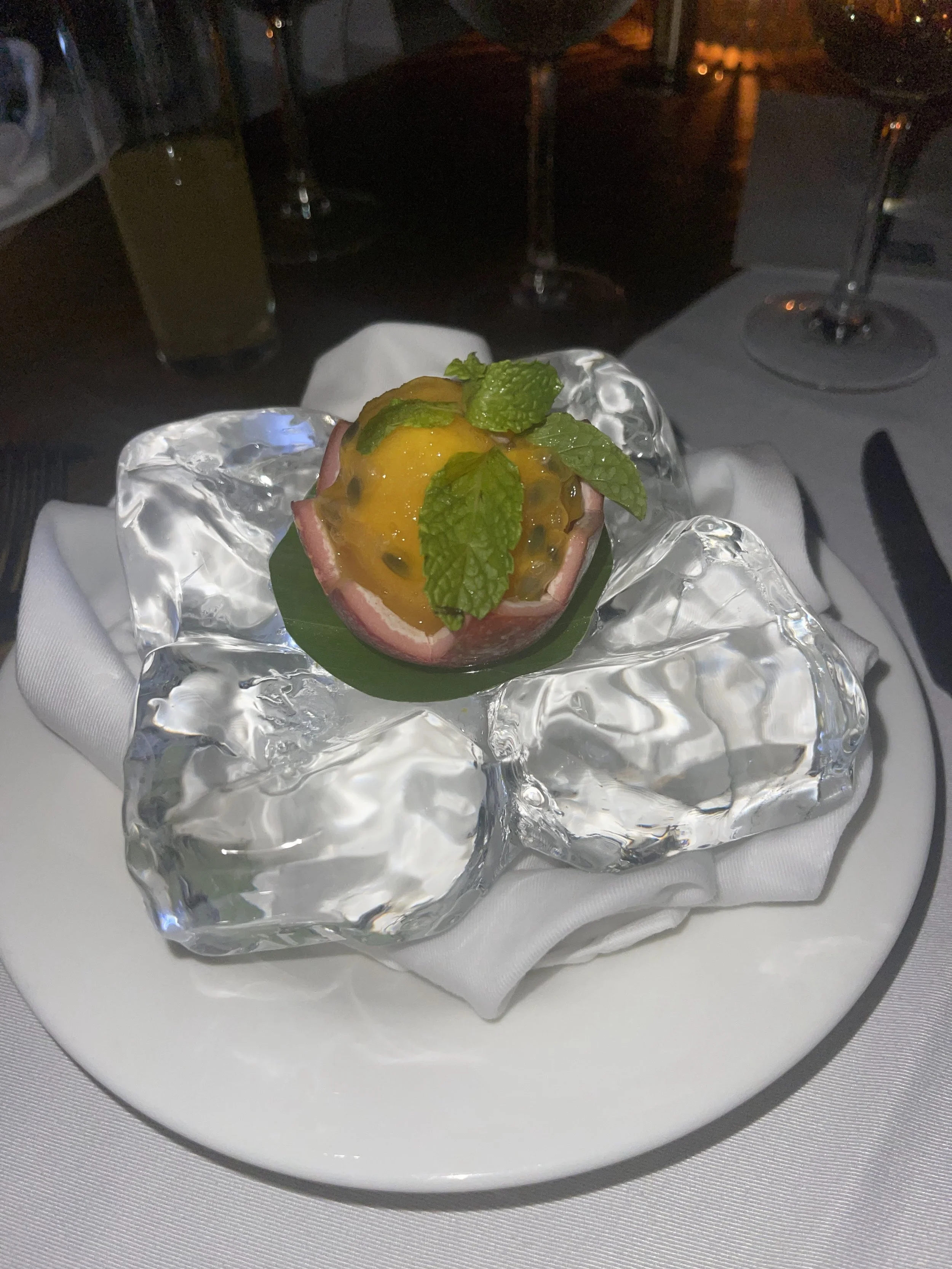
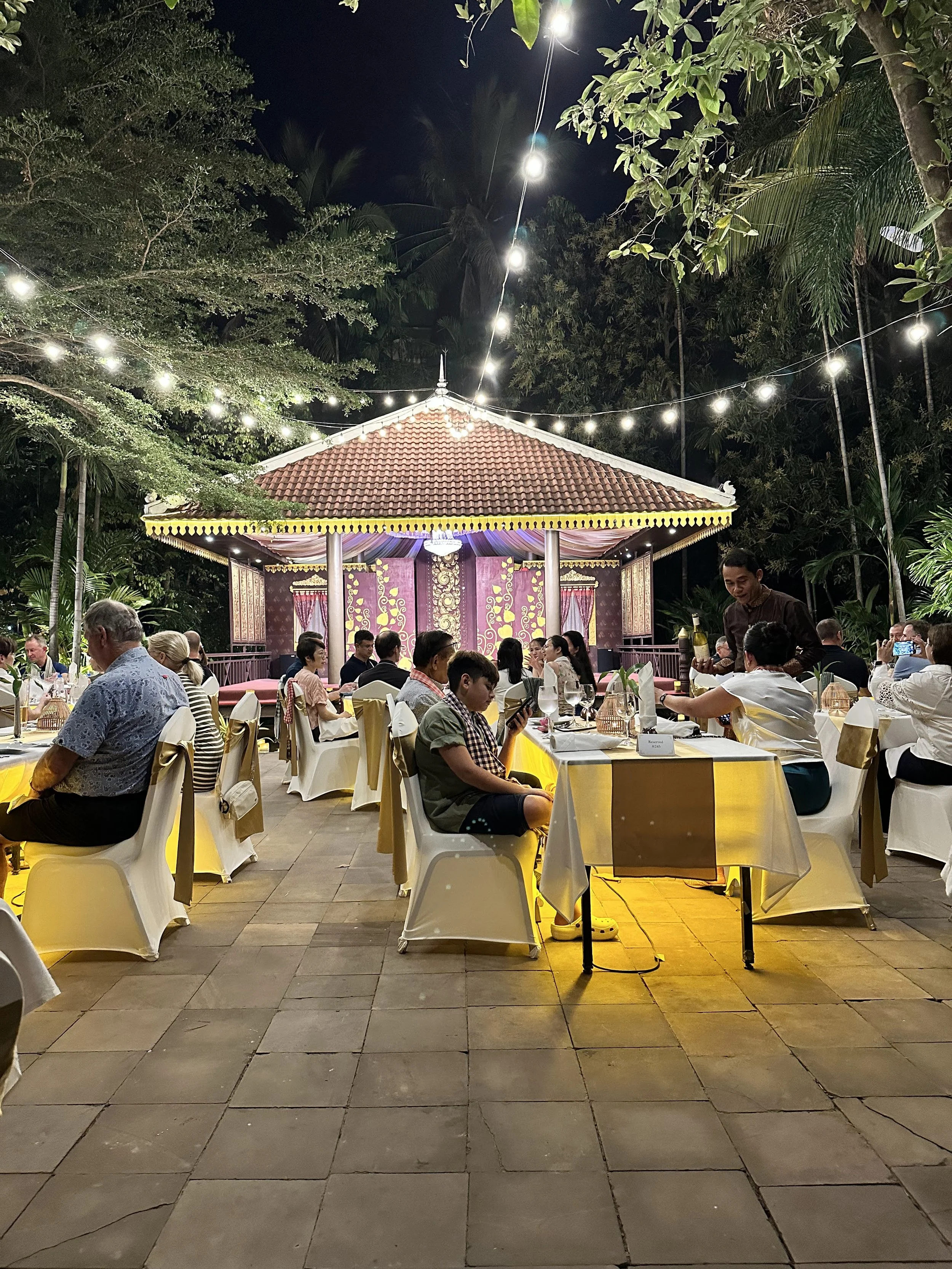
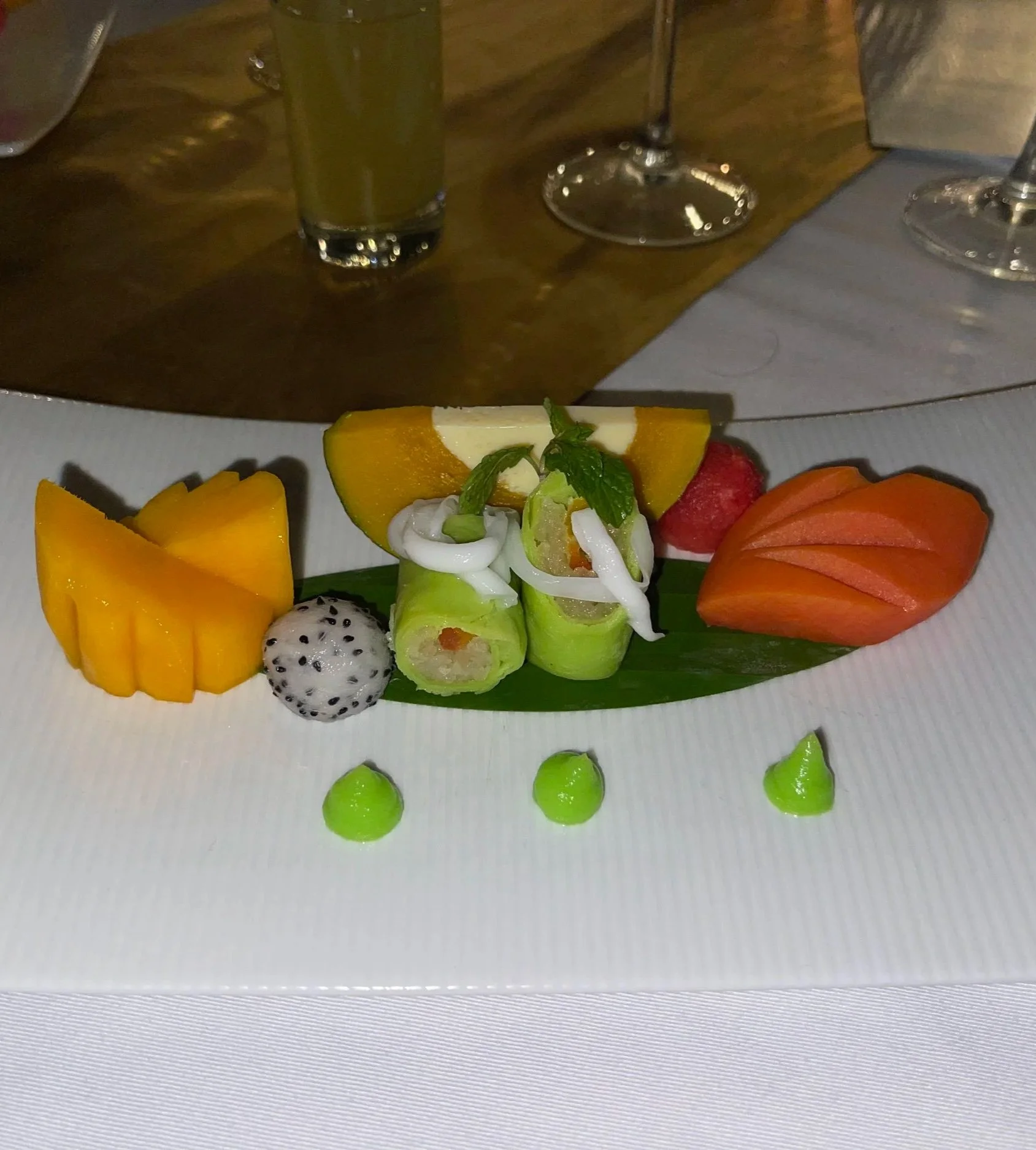
The rest of the night alternated between dinner courses and traditional dances: the coconut dance paired with the morokot coconut soup, the harvest dance paired with homemade sorbet, the fishing dance paired with the traditional fish amok, and the apsara dance paired with glazed fruit sushi rolls.
The next morning we bade farewell to the small lizards climbing on the ceiling at checkout and made the same hourlong drive back to the airport, this time in broad daylight.
We alternated between scorched fields and deep green grass, between which bony cows searched for quality sustenance. After row upon row of short trees, a striking modern structure materialized in the distance, which we knew must be the airport.
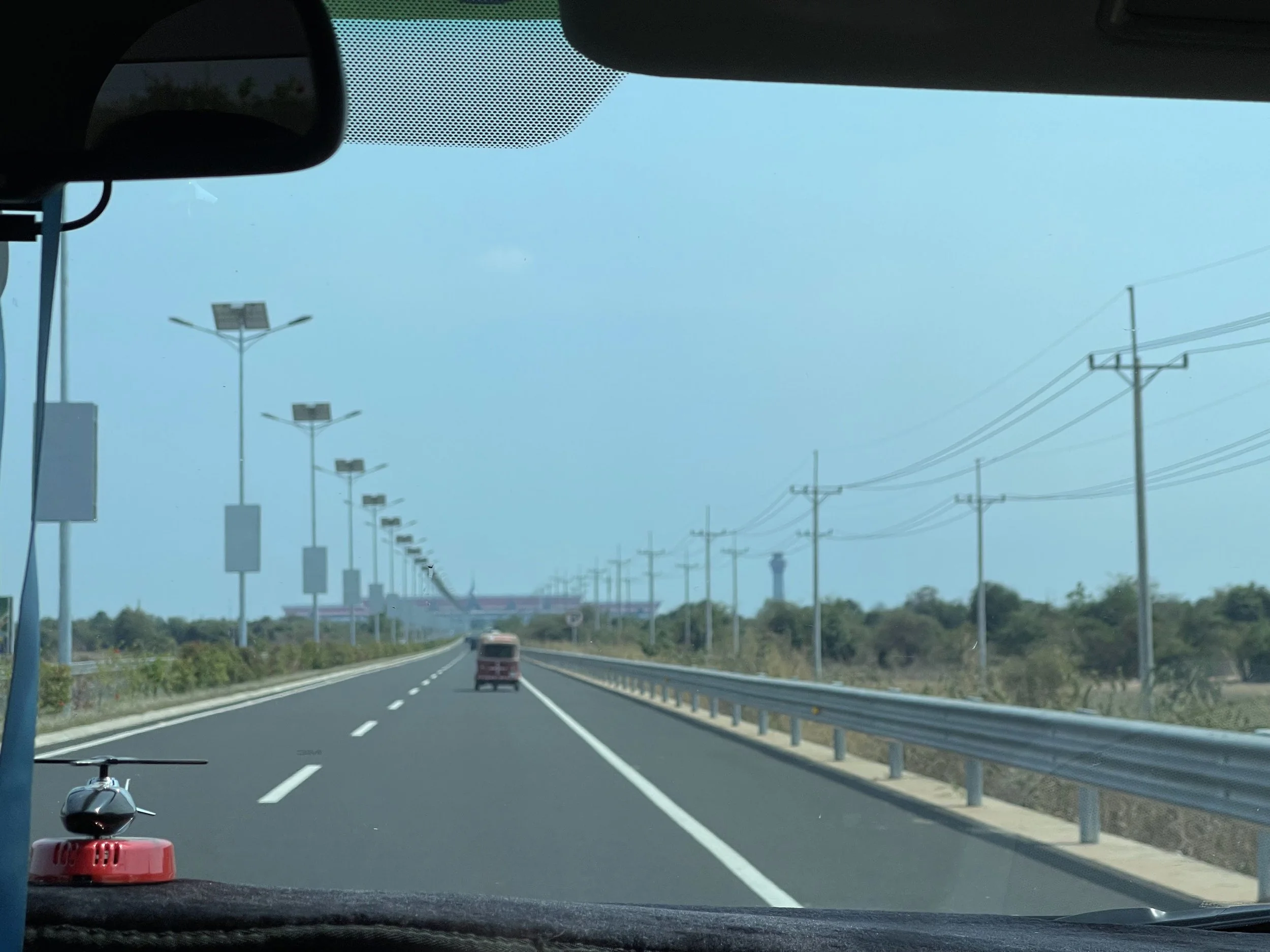
The regal air of Siem Reap–Angkor International Airport felt so out of place against the backdrop of grazing cows and water buffalo that it felt akin to a mirage. Yet the fact of its existence made more sense when we learned it was funded by Yunnan Air Investment, which the Chinese state backs as part of its global Belt and Road Initiative, also known as the New Silk Road. Now knowing that it’s a Chinese infrastructure project, I felt less surprised by the fact that it was more or less deserted.
For his part, our driver Seyha preferred the old airport because it was much closer to the city.
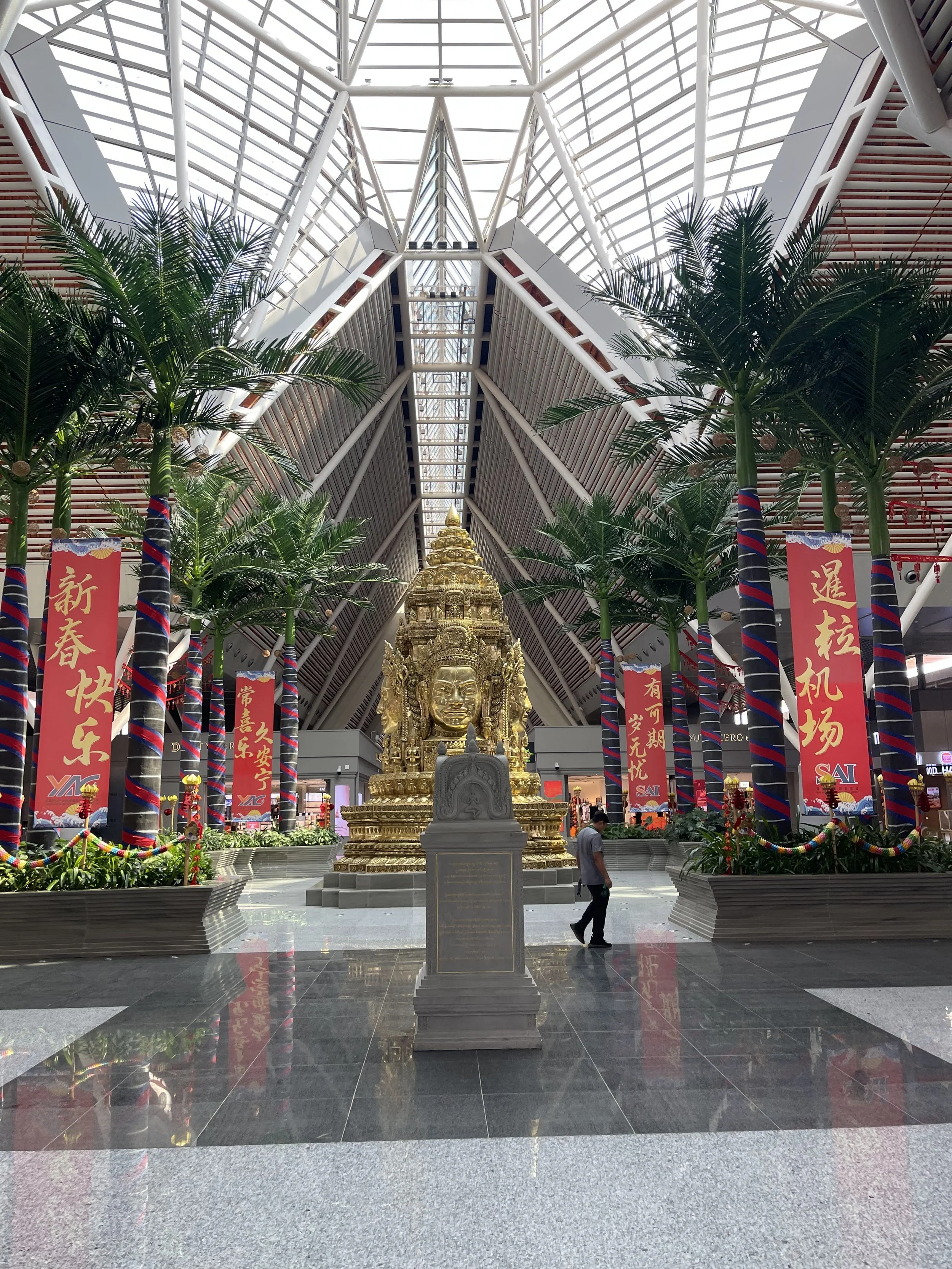
SAI in all its splendor
We had a short delay waiting for Cambodia’s national flag carrier to arrive, during which – given the lack of people-watching to be had – we reflected on our 44 hours in Cambodia, just 4 hours longer than our door-to-door travel from Chicago to Singapore.
Before arriving, I’d worried a bit after reading about the Cambodian government’s authoritarian lean, but our tourism experience was perhaps the most enjoyable of any 44 hours on our trip. It had been a last-minute addition to our itinerary, and had we known how much we’d enjoy Angkor, we certainly would have stayed longer. Perhaps we’d have gone deeper into the wilderness, or to Tonlé Sap, or seen more of Siem Reap, or explored the capital Phnom Penh.
But not this time, as we boarded our plane and rose high into the sky, towards the Mekong River, and out of the Kingdom of Cambodia.
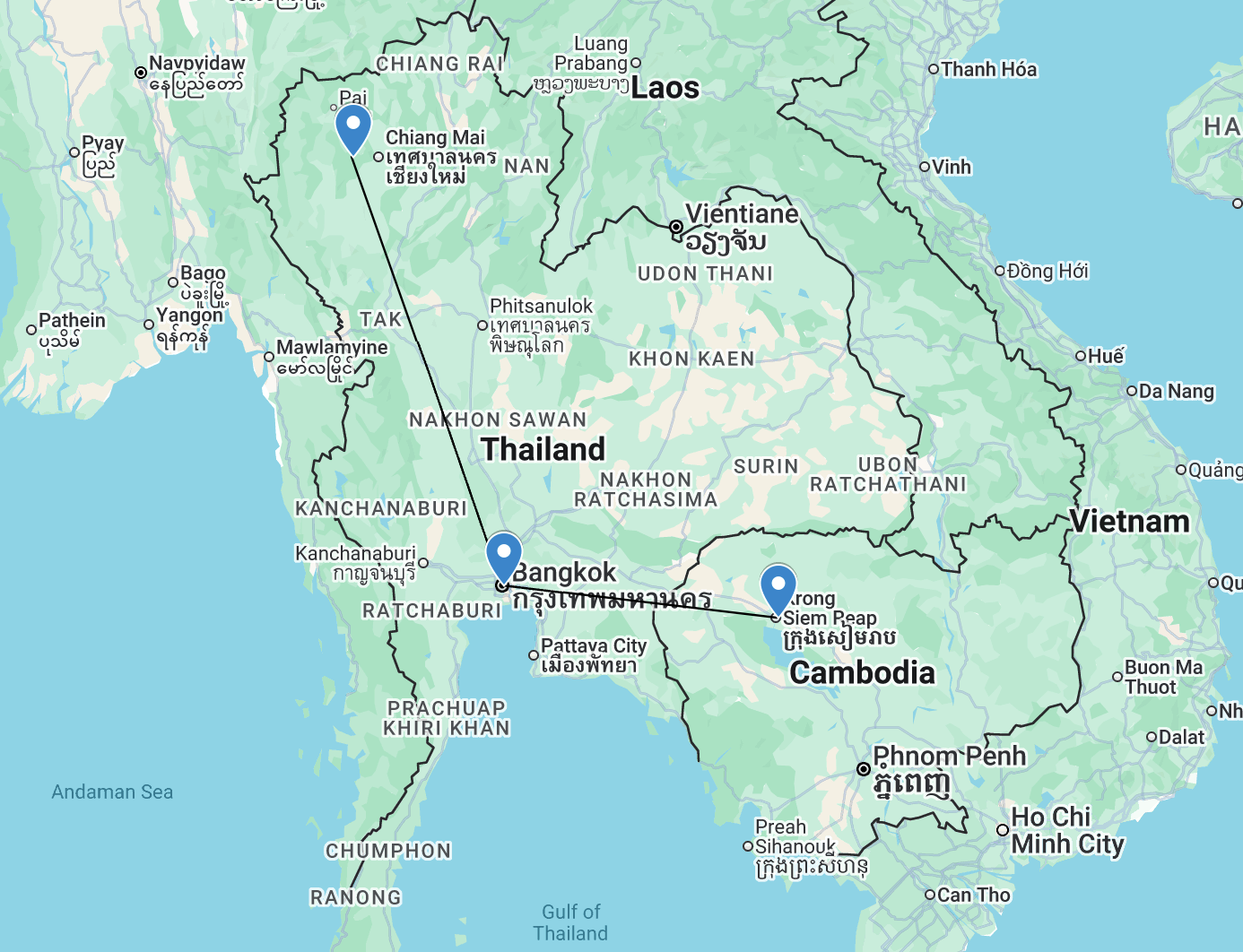
Thank you for reading! In the next post, our honeymoon will conclude in Vietnam with scorpion liquor, bánh xèo, and an overnight cruise.
